
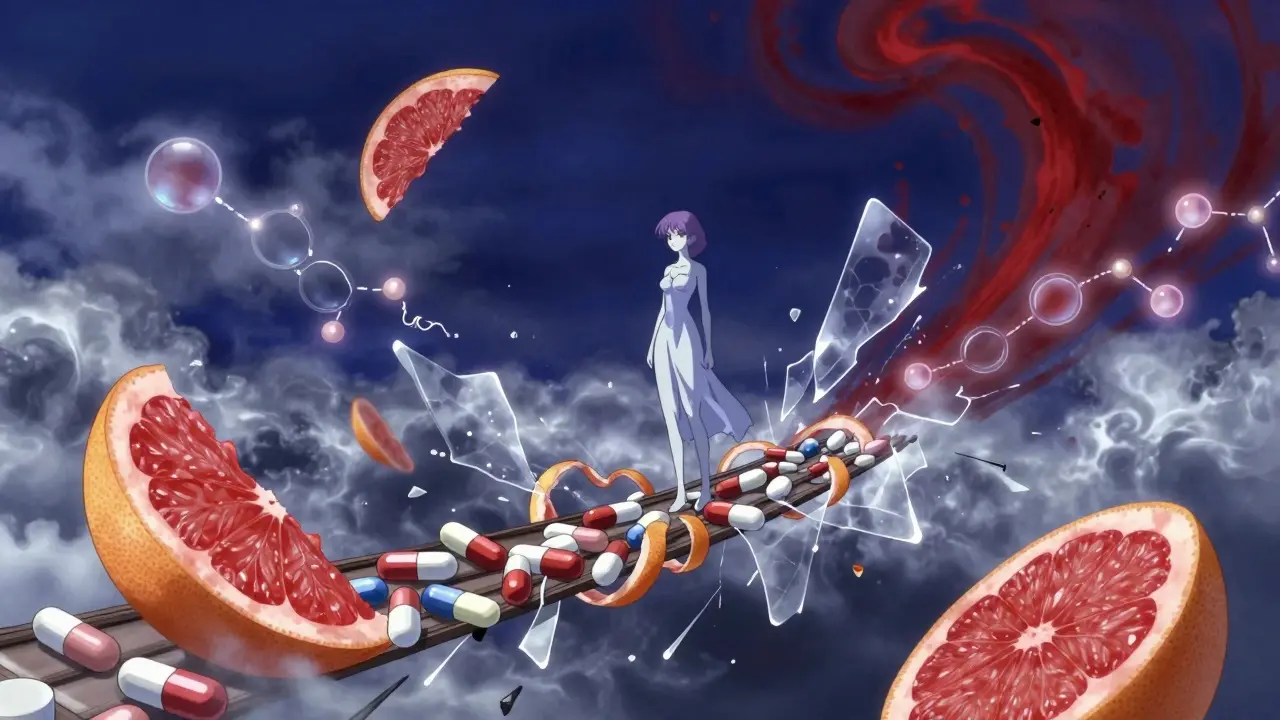
When you take warfarin or an SSRI, you’re not just managing a condition-you’re walking a tightrope between effectiveness and danger. One small thing, like drinking a glass of grapefruit juice, can throw you off balance. It’s not a myth. It’s not a warning you can ignore. The CYP450 enzyme system in your liver and gut is what breaks down these drugs, and grapefruit doesn’t just interfere-it shuts it down, sometimes for days.
How Grapefruit Breaks Down Your Medications
Grapefruit isn’t just a healthy breakfast addition. It’s a chemical disruptor. The real culprits are furanocoumarins-compounds like bergamottin and DHB-that live in the pulp and peel. These don’t just block enzymes temporarily. They permanently damage them. Once CYP3A4, the main enzyme grapefruit targets, gets hit, your gut can’t make new copies fast enough. It takes 24 to 72 hours for your body to replace the destroyed enzymes. That means even if you take your pill at 8 a.m. and drink grapefruit juice at 6 p.m., you’re still at risk.
And it’s not just CYP3A4. Research from Dresser et al. in 1998 showed these compounds also inhibit CYP2C9, CYP2D6, and others. That’s critical because warfarin and many SSRIs rely on these exact enzymes to be broken down safely. This isn’t a minor interaction. It’s a pharmacological earthquake.
Warfarin and Grapefruit: The Silent Risk
Warfarin is a drug with no room for error. Too little, and you risk a clot. Too much, and you bleed internally. It’s metabolized mostly by CYP2C9 (80-90%), with a smaller portion handled by CYP3A4. Grapefruit doesn’t strongly inhibit CYP2C9, but it does-and in some people, that’s enough to tip the scales.
Studies show that in patients with certain CYP2C9 gene variants (like *2 or *3), grapefruit can raise INR levels by 15-25%. That’s not a small jump. It means your blood takes significantly longer to clot. One patient in a Mayo Clinic case report went from an INR of 2.8 to 5.1 after drinking grapefruit juice daily for a week. No symptoms at first-then he woke up with bruising across his chest. He didn’t even realize the juice was the cause.
Here’s the catch: not everyone reacts the same. Some people with the same gene variant never have issues. Others do. That’s why the Clinical Pharmacogenetics Implementation Consortium (CPIC) recommends genetic testing for CYP2C9 if you’re on warfarin and regularly consume grapefruit. The test costs $250-$400. It’s not cheap, but it’s cheaper than a hospital stay.
And yet, only 18% of warfarin prescriptions in 2023 included any warning about grapefruit. That’s a gap between science and practice. Pharmacists know. But patients? Most don’t.
SSRIs and Grapefruit: The Misunderstood Risk
SSRIs are a mixed bag when it comes to grapefruit. Some, like fluoxetine and paroxetine, are broken down by CYP2D6. Grapefruit has minimal effect on this enzyme. So, for those two, the risk is low.
But sertraline? That’s different. It’s metabolized by CYP2C9, CYP2C19, and CYP3A4. And CYP3A4 is grapefruit’s favorite target. A 2015 study found that people who drank grapefruit juice daily for a week had 27-39% higher levels of sertraline in their blood. That’s enough to cause dizziness, nausea, and in rare cases, serotonin syndrome.
Citalopram and escitalopram also use CYP3A4 and CYP2C19. But here’s the twist: a March 2024 study in Clinical Pharmacology & Therapeutics gave 24 healthy volunteers grapefruit juice with escitalopram. No significant change in drug levels. That suggests escitalopram may be safer than other SSRIs in this context.
So what’s the real story? The American Psychiatric Association says grapefruit avoidance is only necessary for sertraline in high-risk patients. For others? It’s not a blanket rule. But if you’re on sertraline and you like your morning smoothie with grapefruit, you’re playing Russian roulette with your nervous system.
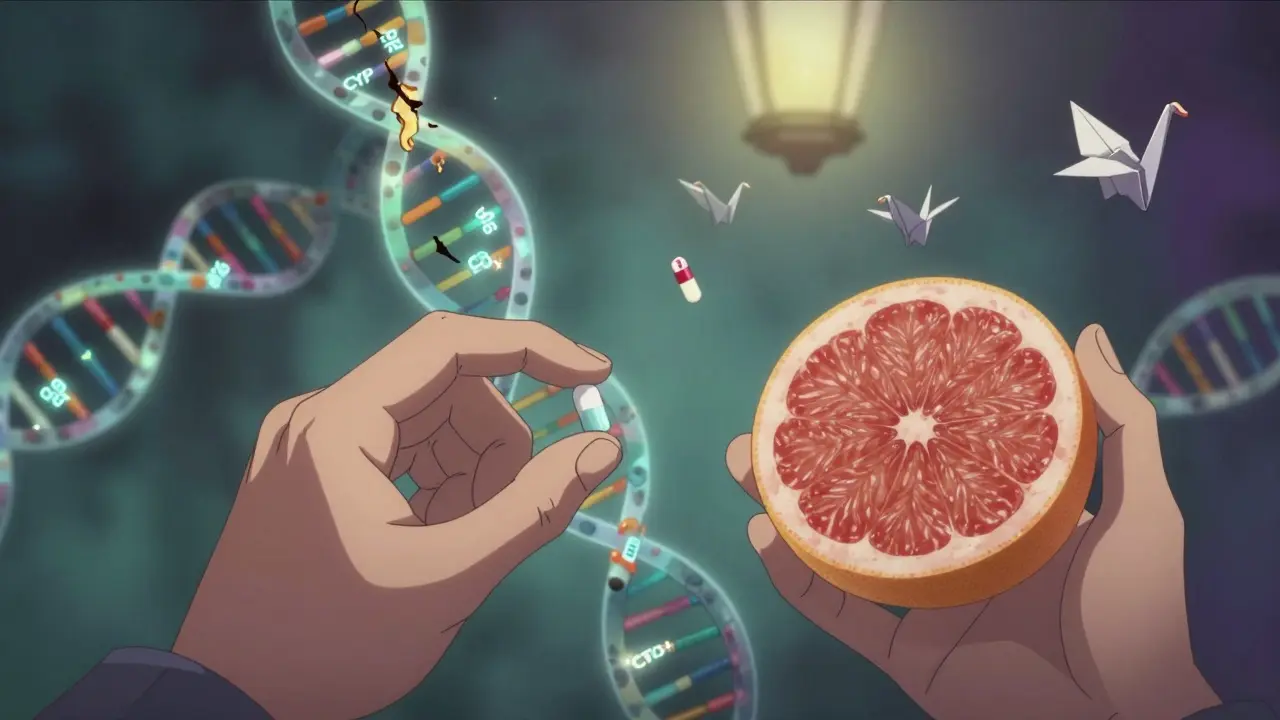
Why This Isn’t Just About Juice
Grapefruit juice isn’t the only problem. The whole fruit? Same issue. Even grapefruit-flavored sodas, candies, or supplements can contain furanocoumarins. And not all grapefruit is equal. In 2023, the FDA warned that newer varieties like ‘Oroblanco’ and ‘Sweetie’ have up to 300% more of the dangerous compounds than traditional pink or white grapefruit.
Also, don’t assume organic or fresh-squeezed is safer. It’s not. The compounds are in the fruit’s biology, not the farming method. And if you think you can just space out your juice and your pill? That’s a myth. The enzyme damage lasts for days. You can’t outwait it.
Who’s at Highest Risk?
It’s not just about what you take-it’s about who you are.
- Older adults: Liver enzymes slow down with age. Grapefruit hits harder.
- People with liver disease: Less ability to clear drugs means even small changes matter more.
- Those on multiple meds: If you’re on warfarin, an SSRI, and a statin? You’re in the danger zone. Grapefruit doesn’t care how many pills you take-it just shuts down the enzymes.
- People with CYP2C9 or CYP2D6 gene variants: Genetic testing can tell you if you’re a slow or ultra-rapid metabolizer. That’s life-saving info.
Here’s a hard truth: 4.7 million Americans take SSRIs. Over 1.2 million take warfarin. And nearly half of U.S. adults take at least one drug that interacts with grapefruit. Yet, only 8% of SSRI prescriptions and 18% of warfarin prescriptions warn about it. That’s not negligence-it’s a systemic failure in communication.
What You Should Do Right Now
Don’t wait for your doctor to bring it up. Don’t assume your pharmacist already told you. Here’s what to do:
- Check your meds. Look up your prescription on Drugs.com or the FDA’s drug interaction database. If it says “avoid grapefruit,” take it seriously.
- If you’re on warfarin and eat grapefruit regularly, ask for a CYP2C9 genetic test. It’s not routine, but it should be.
- If you’re on sertraline, stop grapefruit. Period. No exceptions.
- For other SSRIs, talk to your prescriber. Don’t guess. Ask: “Is grapefruit safe with this drug?”
- Switch to orange or tangerine juice. They don’t have furanocoumarins. Safe. Tasty. Same vitamin C.
And if you’ve been drinking grapefruit juice for years and just found out this is a problem? Don’t panic. Stop. Talk to your doctor. Get your INR checked if you’re on warfarin. Monitor for side effects if you’re on sertraline. Your body will recover once you remove the trigger.
Why This Matters More Than Ever
Grapefruit consumption in the U.S. has gone up 17% since 2019. People are eating more of it because they think it’s healthy. Meanwhile, the population is aging. More people are on multiple medications. The European Medicines Agency predicts a 22% rise in grapefruit-related adverse events by 2030.
This isn’t a niche issue. It’s a public health blind spot. We’ve got the science. We’ve got the data. What we’re missing is the conversation.
Next time you reach for that grapefruit, ask yourself: Is this helping me-or is it quietly putting me at risk?
Can I drink grapefruit juice if I take warfarin?
It’s not safe to assume yes. Grapefruit can inhibit CYP2C9 and CYP3A4, which metabolize warfarin. In some people-especially those with CYP2C9 gene variants-it can raise INR levels by 15-25%, increasing bleeding risk. If you take warfarin, avoid grapefruit entirely unless you’ve had genetic testing and your doctor says it’s safe.
Do all SSRIs interact with grapefruit?
No. Fluoxetine and paroxetine are mainly broken down by CYP2D6, which grapefruit affects only weakly. Sertraline, citalopram, and escitalopram use CYP3A4 and CYP2C19, so they’re more at risk. Sertraline has the strongest evidence for interaction, with studies showing 27-39% higher blood levels after grapefruit use. Escitalopram appears to have lower risk based on a 2024 study. Always check with your provider.
How long does grapefruit affect drug metabolism?
Up to 72 hours. Grapefruit doesn’t just block enzymes-it destroys them. Your gut needs time to make new ones. Even if you take your medication 12 hours after drinking grapefruit juice, the enzymes are still damaged. Time separation doesn’t prevent the interaction.
Is orange juice safe instead of grapefruit juice?
Yes. Sweet oranges, tangerines, and most citrus juices (except Seville oranges and pomelos) don’t contain furanocoumarins. They won’t interfere with CYP450 enzymes. Switching to orange juice is a simple, safe alternative if you’re on warfarin, sertraline, or other affected drugs.
Can I eat grapefruit if I take it once a week?
No. Even occasional grapefruit consumption can cause enzyme inhibition. The damage lasts for days. If you’re on warfarin or sertraline, there’s no safe frequency. The risk isn’t about how much you eat-it’s about the irreversible effect on your liver enzymes. Avoid it completely.
What should I do if I accidentally ate grapefruit while on warfarin?
Monitor for signs of bleeding: unusual bruising, nosebleeds, blood in urine or stool, headaches, dizziness. Contact your doctor and ask for an INR test within 3-5 days. Don’t wait for symptoms. Early detection can prevent serious complications.
Medication safety isn’t about following rules blindly. It’s about understanding what’s happening inside your body. Grapefruit isn’t the enemy. But when it meets the wrong drugs, it becomes a silent threat. Know your meds. Know your body. And when in doubt-skip the grapefruit.
Jody Fahrenkrug
January 18, 2026 AT 09:13I used to drink grapefruit juice every morning with my pills until my pharmacist pulled me aside last year. Honestly? I thought it was just an old wives’ tale. Then I got my INR spiked to 5.3 after a weekend of ‘just one glass.’ Now I drink orange juice and feel way less anxious about bleeding out in my sleep. Thanks for laying this out so clearly.
Samyak Shertok
January 18, 2026 AT 11:02Oh wow, so now we’re treating grapefruit like a villain in a Marvel movie? ‘Beware the Furanocoumarin!’ Next you’ll tell me vitamin C is a government conspiracy. People have been eating citrus for centuries-your body isn’t some fragile porcelain doll that shatters at the sight of a peel. If you’re on warfarin and still alive after 30 years of grapefruit, maybe stop being so scared of your own liver.
Stephen Tulloch
January 19, 2026 AT 03:27LMAO at the ‘genetic testing for CYP2C9’ advice. 💸$400 to find out you’re a slow metabolizer? Bro, just stop drinking grapefruit juice. That’s not science-that’s Big Pharma’s new revenue stream. Also, sertraline + grapefruit = serotonin syndrome? Sure, Jan. I’m sure your 2015 study didn’t have a tiny sample size. Meanwhile, I’m sipping my grapefruit-mint smoothie with my 100mg sertraline like a boss 🍊😎
Joie Cregin
January 19, 2026 AT 12:03Thank you for writing this. I’ve been on escitalopram for 4 years and always wondered why my doctor never mentioned grapefruit. I’ve been drinking it daily since college. After reading your post, I switched to tangerine juice yesterday and honestly? It tastes just as good. My anxiety didn’t spike, my skin isn’t breaking out, and I’m not hallucinating. Sometimes the simplest changes make the biggest difference. You’ve given me peace of mind. 🌿
Corey Sawchuk
January 21, 2026 AT 11:35My mom’s on warfarin and drinks grapefruit juice every day. She’s 72, no issues. She’s also never had a stroke or bleed. Maybe the real problem isn’t the juice but how we scare people into thinking every interaction is a death sentence. I get the science but this feels like overkill. Just talk to your doctor. Don’t panic.
Rob Deneke
January 21, 2026 AT 22:09Good post. Real talk though. If you’re on meds and you don’t know how they interact with food you’re basically flying blind. I’ve seen too many people get hospitalized because they thought ‘it’s just juice.’ Don’t be that person. Check your meds. Ask your pharmacist. They’re not just the guy behind the counter-they’re your safety net. And yeah skip the grapefruit. Your future self will thank you
Chelsea Harton
January 23, 2026 AT 10:11grapefruit is fine if you dont have liver probz. also sertraline is just a drug that makes you cry anyway so what does it matter if you get a little extra
waneta rozwan
January 24, 2026 AT 15:24Oh honey. You think this is bad? Try mixing grapefruit with statins. I watched my neighbor’s husband turn into a walking liver failure ad. He thought ‘natural’ meant ‘safe.’ Spoiler: it didn’t. You’re lucky you only got a warning. Most people don’t get one until they’re in the ER with a hemoglobin of 5. Don’t be cute. Don’t be clever. Just. Stop. Drinking. It.
Kasey Summerer
January 25, 2026 AT 17:58As a guy who grew up in a Lebanese household where grapefruit with breakfast was a religion, I gotta say… I switched to blood orange juice after my cardiologist nearly cried when he saw my INR. We still have the fruit, but now it’s just for decoration. 🍊🫡 My abuela still says ‘you’re too scared of food now’ but I’m alive and my INR’s stable. Sometimes tradition has to make room for science.