
Deprescribing Risk Assessment Tool
How to Use This Tool
This tool assesses your potential risk related to polypharmacy based on common high-risk medication classes. It's not a medical diagnosis. Always consult with your healthcare provider before making changes to your medications.
Let's assess your medication risk
Answer the following questions about your current medications. Your answers will help identify potential areas for review with your healthcare provider.
More than 40% of older adults take five or more medications daily. For many, that means more pills than meals. And while those drugs might have helped at one point, today they could be causing more harm than good. Headaches, dizziness, confusion, falls, stomach bleeds, even kidney damage-these aren’t just side effects. They’re warning signs that the medication list needs a serious rethink. This is where deprescribing comes in. It’s not about stopping meds cold turkey. It’s a careful, step-by-step process to remove drugs that no longer serve you-especially when the risks outweigh the benefits.
What Exactly Is Deprescribing?
Deprescribing is the opposite of prescribing. Instead of adding more pills, you’re thoughtfully removing them. It’s not lazy or lazy medicine. It’s the opposite: a deliberate, evidence-based review of every drug on your list. The goal? Reduce side effects, lower the chance of hospital visits, and improve your daily life.This isn’t new. Canadian researchers Barbara Farrell and Cara Tannenbaum started building the first real frameworks around 2010. By 2015, they launched deprescribing.org, a free resource used by doctors and pharmacists worldwide. Today, it’s the gold standard. Their work showed that cutting back on unnecessary meds doesn’t make people sicker-it often makes them feel better.
Take proton-pump inhibitors (PPIs), for example. These are common acid reflux drugs like omeprazole. Many people take them for years-even decades-long after their symptoms are gone. But long-term use raises the risk of bone fractures, kidney problems, and even infections. Deprescribing guidelines say: if you’ve been on a PPI for more than 8 weeks with no clear reason, it’s time to try tapering off. Slowly. With monitoring.
The Big Problem: Polypharmacy
Polypharmacy isn’t just a fancy word. It’s the reality for millions. When someone takes five or more medications, the chance of harmful interactions jumps. A 2023 study from the American Geriatrics Society found that inappropriate polypharmacy leads to 30% of hospital admissions in adults over 65. That’s not a small number. That’s one in three.Why does this happen? Often, it’s because each doctor treats one condition-high blood pressure, diabetes, arthritis-and doesn’t know what the others have prescribed. Pills pile up. No one steps back to ask: “Is this still helping?”
Some meds were meant for short-term use but became permanent. A benzodiazepine for anxiety after surgery. An antipsychotic for sleep. An opioid for back pain that never went away. These drugs don’t always get re-evaluated. And that’s dangerous.
Five Medication Classes That Are Prime Targets
Not all meds are equal when it comes to deprescribing. Some have clearer evidence that stopping them improves safety. The top five classes, according to deprescribing.org, are:- Proton-pump inhibitors (PPIs) - Often taken way too long. Tapering reduces risk of kidney and bone damage.
- Benzodiazepines and sleep aids (BZRAs) - Like lorazepam or zolpidem. These increase fall risk and memory problems in older adults.
- Antipsychotics - Sometimes used for agitation in dementia. But they raise stroke risk and cause stiffness, tremors, and sedation.
- Antihyperglycemics (diabetes drugs) - Especially in frail older adults. Too-low blood sugar can be deadly.
- Opioid painkillers - Long-term use leads to tolerance, dependence, and overdose risk-even at low doses.
Each of these has a published, step-by-step deprescribing protocol. For example, the PPI guideline says: identify patients using STOPP/START criteria, check if the original reason still exists, reduce the dose slowly over 4-8 weeks, then monitor for rebound symptoms. No rush. No guesswork.
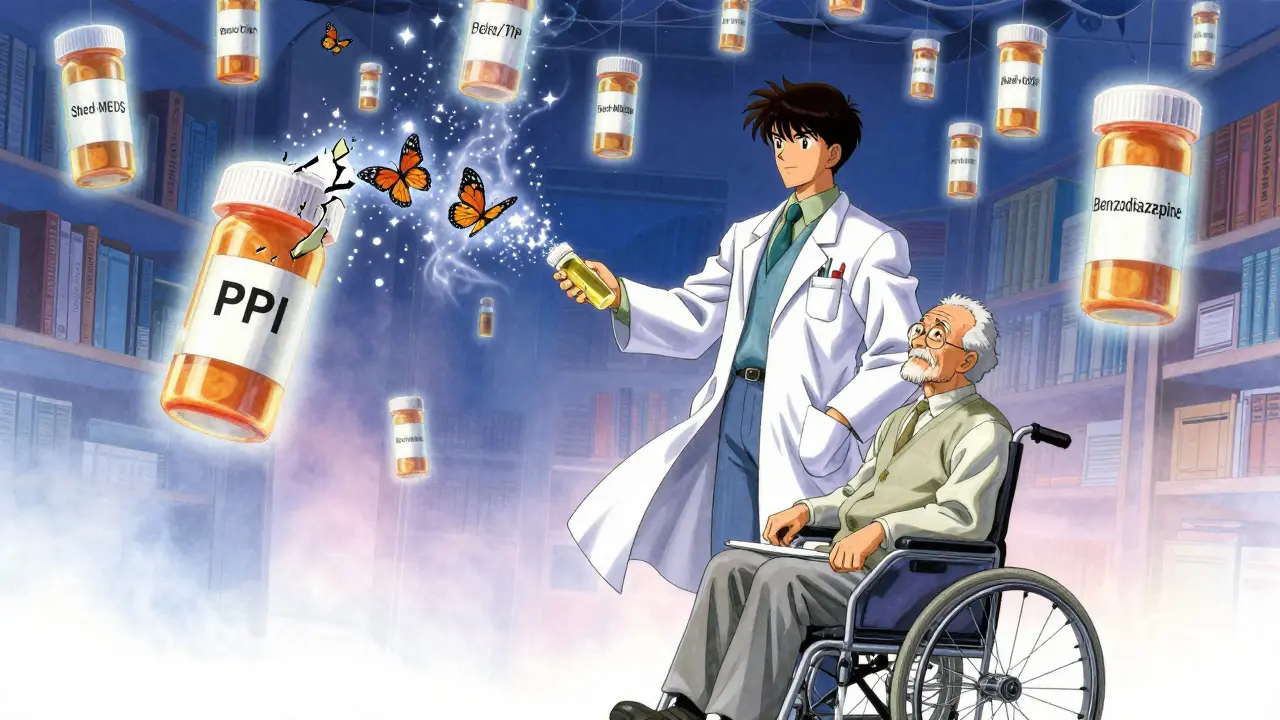
The Shed-MEDS Framework: A Proven Method
One of the most tested frameworks is called Shed-MEDS. It stands for:- Best Possible Medication History - Get the full list. Not what the patient remembers. Not what the chart says. What’s actually being taken.
- Evaluate - Use tools like the Beers Criteria (updated in 2023) to flag potentially inappropriate drugs.
- Deprescribing Recommendations - Prioritize which meds to cut first based on risk, benefit, and patient goals.
- Synthesis - Create a clear plan with the patient, including tapering schedule and follow-up.
A 2023 JAMA Internal Medicine trial with 372 older adults showed this method worked. Patients on the Shed-MEDS plan dropped an average of 1.8 medications-and stayed just as safe. Hospitalizations didn’t go up. Side effects didn’t spike. Quality of life improved.
Who Should Be Doing This?
Deprescribing isn’t something a doctor can do in a 7-minute visit. It needs time. Collaboration. And expertise.Pharmacists are key. In settings where pharmacists lead the process, deprescribing success rates jump by 35-40%. Why? They’re trained in drug interactions, tapering schedules, and patient counseling. They have the time to sit down, review the full list, and talk through concerns.
But in most U.S. primary care offices, pharmacists aren’t part of the team. Doctors are stretched thin. A 2022 Canadian study found only 15% of primary care practices have any formal deprescribing process. That’s not because doctors don’t care. It’s because the system doesn’t support it.
That’s changing. The American Medical Association issued its first deprescribing policy in June 2024, saying doctors should “routinely assess the continuing appropriateness of all medications.” Medicare is also moving forward-starting in 2026, deprescribing metrics will count toward doctor pay under the Merit-Based Incentive Payment System.
What Patients Say
Patients aren’t just passive recipients here. Their input matters.A 2022 study found 65% of older adults felt relieved when they reduced their pill count. “I stopped feeling like a pharmacy,” one woman said. Another reported better sleep and less confusion after stopping a long-term sleep aid.
But 22% felt anxious. “I’ve taken this pill for 15 years,” one man told researchers. “What if I get sick again?” That fear is real. And it’s why shared decision-making is non-negotiable.
Successful deprescribing doesn’t happen with a note on the chart. It happens with a conversation: “Why did we start this? Is it still helping? What happens if we stop? What would you like your life to look like in six months?”
Barriers and Real-World Challenges
Even with strong evidence, deprescribing still faces big hurdles.First, most clinical guidelines don’t include deprescribing. A 2024 analysis of 3,569 recommendations found only 7% addressed stopping meds. The rest are about starting them. That creates a blind spot.
Second, electronic health records (EHRs) aren’t built for it. Most systems still default to auto-renewing prescriptions. If a doctor doesn’t actively cancel a refill, the pharmacy sends it again. No one checks.
Third, there’s a lack of case examples. Clinicians say they need more real-world stories: “How do I taper this opioid in someone with chronic pain and depression?” “What if the patient’s family pushes back?”
And then there’s the fear of backlash. Some worry that stopping a med will be blamed if something goes wrong-even if the med was the problem.
Dr. Joseph Teno from Brown University warns against indiscriminate deprescribing. “Some older adults with advanced dementia need certain meds for comfort,” he says. “Taking away a sedative that helps them sleep peacefully isn’t progress-it’s neglect.”
That’s why deprescribing isn’t about cutting meds for the sake of cutting. It’s about aligning treatment with personal goals.
How to Get Started
If you’re a patient or caregiver wondering where to begin:- Make a complete list of every pill, patch, inhaler, and supplement you take. Include over-the-counter drugs and herbal products.
- Ask your doctor: “Which of these are still necessary? Which might be doing more harm than good?”
- Request a medication review with a pharmacist. Many insurance plans now cover this.
- Don’t stop anything on your own. Tapering is critical for safety.
- Use deprescribing.org’s free tools to prepare for your visit. They have printable checklists and guides for common drugs.
If you’re a clinician:
- Start with one high-risk class-like benzodiazepines or PPIs.
- Use STOPP/START criteria or the Beers Criteria to flag candidates.
- Partner with your pharmacy team. Even one pharmacist can transform your practice.
- Document your decisions clearly: “Deprescribed lorazepam due to fall risk. Tapered over 6 weeks. No withdrawal symptoms.”
- Track outcomes. Did the patient sleep better? Fall less? Feel clearer-headed?
The Future of Deprescribing
The numbers are clear. By 2030, 1 in 6 people worldwide will be over 65. More meds. More side effects. More hospital stays.But the tools are here. The evidence is strong. The systems are starting to change.
The NIH is funding research to create deprescribing guidelines for antidepressants, anticoagulants, and other complex drugs. AI tools are being built to scan EHRs and flag patients who might benefit from deprescribing. In Canada, the national DIGE program has made deprescribing routine. In the U.S., it’s catching up.
By 2030, experts predict deprescribing assessments will be as common as checking blood pressure. That’s not a dream. It’s a necessity.
Medication isn’t always the answer. Sometimes, less is more. And knowing when to stop is just as important as knowing when to start.
Is deprescribing safe?
Yes, when done properly. Multiple studies, including a 2023 JAMA trial with over 370 older adults, show that deprescribing reduces medication burden without increasing hospitalizations or death. The key is a slow, monitored taper-not stopping cold turkey. Side effects from withdrawal are rare when protocols are followed.
Can I stop my meds on my own?
No. Some medications, like benzodiazepines, antipsychotics, or opioids, can cause dangerous withdrawal symptoms if stopped suddenly. Others, like blood pressure or diabetes drugs, may cause rebound effects. Always work with your doctor or pharmacist to create a safe tapering plan.
What if my doctor won’t help with deprescribing?
Ask for a referral to a clinical pharmacist or geriatric specialist. Many hospitals and community pharmacies now offer medication reviews. You can also use deprescribing.org’s free resources to prepare a list of concerns and bring it to your appointment. Sometimes, showing up with evidence makes a difference.
How long does it take to taper off a medication?
It varies. For PPIs, it’s often 4-8 weeks. For benzodiazepines, it can take 3-6 months. For antipsychotics, it may be even longer. The goal is to reduce slowly enough to avoid withdrawal, but quickly enough to see benefits. Your provider will tailor the pace to your health and symptoms.
Are there tools I can use at home?
Yes. Deprescribing.org offers free, downloadable algorithms for common drugs like PPIs, sleep aids, and antipsychotics. The American Geriatrics Society’s Beers Criteria is also publicly available. These aren’t DIY guides-they’re reference tools to help you ask better questions during your appointments.
Does deprescribing save money?
Yes. A 2023 Canadian study found that for every $1 spent on deprescribing programs, healthcare systems saved $3.20 through reduced medication costs and fewer hospital visits. For patients, cutting five unnecessary prescriptions can save $500-$1,200 a year.
Why isn’t deprescribing more common?
Three main reasons: time, training, and systems. Most primary care visits are under 10 minutes. Doctors aren’t trained in tapering protocols. EHRs don’t flag when a med might be unnecessary. And until recently, guidelines focused only on prescribing, not stopping. Change is happening, but slowly.
srishti Jain
December 29, 2025 AT 23:27My grandma took 12 pills a day. She stopped 5 after a pharmacist review. Suddenly she could walk without a cane. No magic. Just common sense.
Nadia Spira
December 31, 2025 AT 12:33Deprescribing? Sounds like neoliberal bio-power disguised as patient autonomy. You're not reducing polypharmacy-you're outsourcing pharmaceutical abandonment to underpaid pharmacists while the medical-industrial complex recalibrates its profit margins. The Beers Criteria? A sanitized euphemism for rationing care under the guise of safety. Wake up. This isn't medicine. It's actuarial triage dressed in clinical jargon.
Joseph Corry
January 1, 2026 AT 19:12Interesting how the piece romanticizes deprescribing as if it were a benign, universally applicable intervention. The JAMA trial you cite? N=372, single-center, short-term follow-up. Where’s the data on long-term cognitive outcomes? On all-cause mortality? On the 23% of patients who developed rebound acid reflux after PPI cessation and ended up in the ER? You’re cherry-picking wins while ignoring the messy, individualized reality of geriatric pharmacotherapy. This isn’t evidence-based-it’s advocacy masquerading as science.
kelly tracy
January 3, 2026 AT 07:03So now we’re supposed to trust pharmacists with our lives? Let me guess-the same ones who can’t tell the difference between a statin and a stool softener? And who wrote this? Someone who’s never had to watch their parent spiral into confusion after a med change? This isn’t empowerment. It’s negligence wrapped in a pretty infographic.
Hayley Ash
January 3, 2026 AT 07:14Oh wow the Shed-MEDS framework sounds so fancy I almost forgot it's just a fancy word for 'let's guess which pills to take away'... and don't even get me started on 'patient goals'-like my aunt's goal is to not die before her cat? Yeah sure. Also why is everyone acting like doctors are villains? Maybe they're just trying not to get sued if you drop dead after stopping your blood pressure med? Just a thought
Cheyenne Sims
January 3, 2026 AT 20:51The notion that deprescribing is a universally beneficial intervention is not only scientifically unsound, it is ethically precarious. The Beers Criteria, while well-intentioned, lacks granularity in distinguishing between functional decline and iatrogenic harm. Furthermore, the assertion that pharmacists are primary agents of deprescribing neglects the foundational role of the prescribing physician in longitudinal care coordination. The JAMA trial cited demonstrates statistical equivalence in hospitalization rates-not superiority. To imply that reducing pill burden equates to improved quality of life is to conflate correlation with causation. Without robust, longitudinal, multi-center RCTs controlling for socioeconomic confounders, this remains hypothesis, not protocol.
Colin L
January 4, 2026 AT 19:08I’ve been on a PPI for 12 years. My doctor never asked if I still needed it. I just kept getting the refill. Then one day I stopped cold turkey because I was tired of the cost and the side effects. I had heartburn so bad I couldn’t sleep. I ended up in the ER. They gave me IV omeprazole and told me I’d be on it forever. Now I’m scared to even ask about stopping anything. What if I’m the one who gets hurt? What if I’m the exception? Everyone says ‘it’s safe’ but no one ever says ‘what if it’s not safe for you?’ I don’t want to be a statistic. I want to be seen. And I’m tired of being told what’s good for me by people who’ve never sat in my chair.
Shae Chapman
January 5, 2026 AT 19:09This gave me chills 😭 My dad cut back on 4 meds last year and now he laughs again. He remembers my birthday. He walks the dog without napping. I cried when he said, ‘I feel like me again.’ Thank you for writing this. Please share this with every doctor you know. We need more of this, not less. 💙