
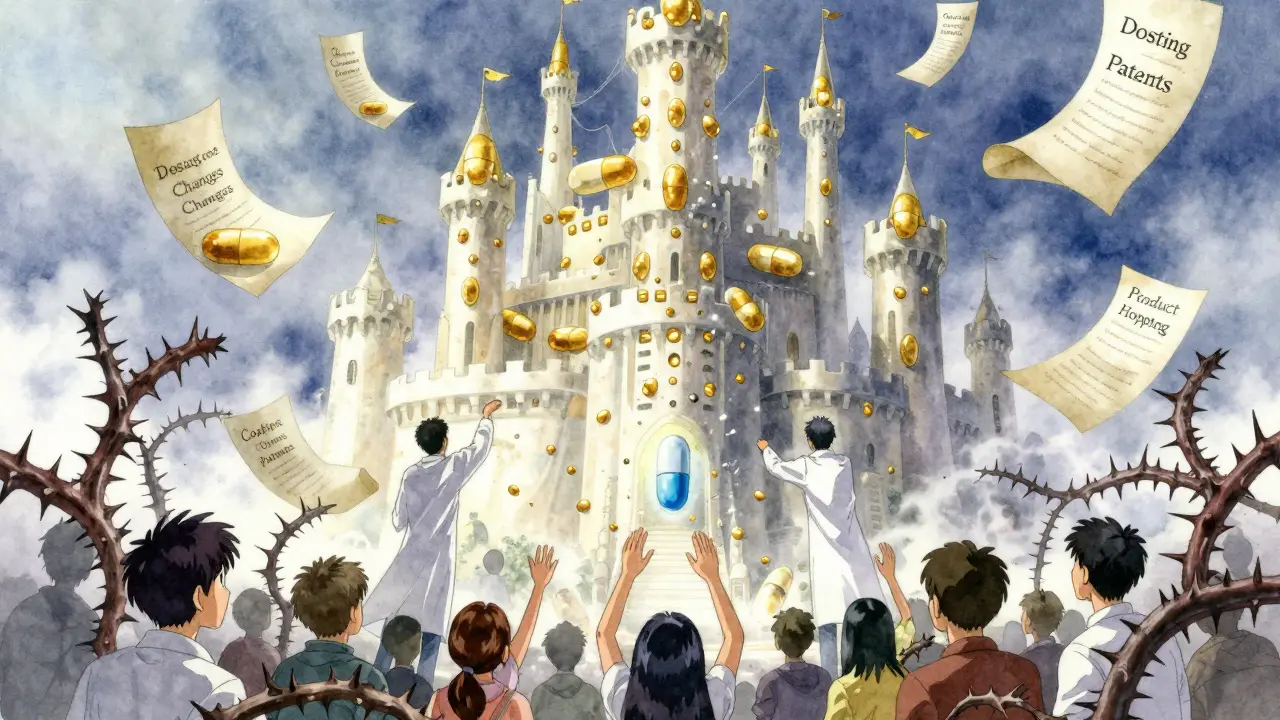
Every year, millions of people rely on prescription drugs to manage chronic conditions - diabetes, arthritis, autoimmune diseases. But for many, the cost of these medicines keeps rising, even when the original patent should have expired. That’s not an accident. It’s the result of a legal strategy called evergreening.
What Evergreening Really Means
Evergreening isn’t about inventing new drugs. It’s about keeping old ones expensive. When a drug’s 20-year patent runs out, generic manufacturers can legally copy it and sell it for a fraction of the price. But before that happens, big pharmaceutical companies file new patents - not for better medicine, but for tiny changes. A different pill shape. A new dosage time. A slightly altered chemical form. These aren’t breakthroughs. They’re tweaks.
The goal? To reset the clock. Every new patent adds another 5, 7, or even 20 years of market control. The original drug stays off the market. Generics stay out. Prices stay high. The patient pays the difference.
How It Works: The Playbook
Pharma companies don’t guess at these moves. They plan them years in advance. Teams of patent lawyers, chemists, and regulatory experts work 5 to 7 years before a patent expires to find something - anything - that can be patented again.
- Extended-release versions: Switching from a pill you take twice a day to one you take once. Sounds convenient? It’s also patentable.
- Combination drugs: Bundling two old drugs into one pill. Even if neither component is new.
- Formulation changes: Changing the coating, color, or filler inside the pill. No therapeutic benefit - just a new patent.
- Product hopping: Pulling the original drug off the market and pushing patients to the new version. If the old one’s no longer available, generics can’t replace it easily.
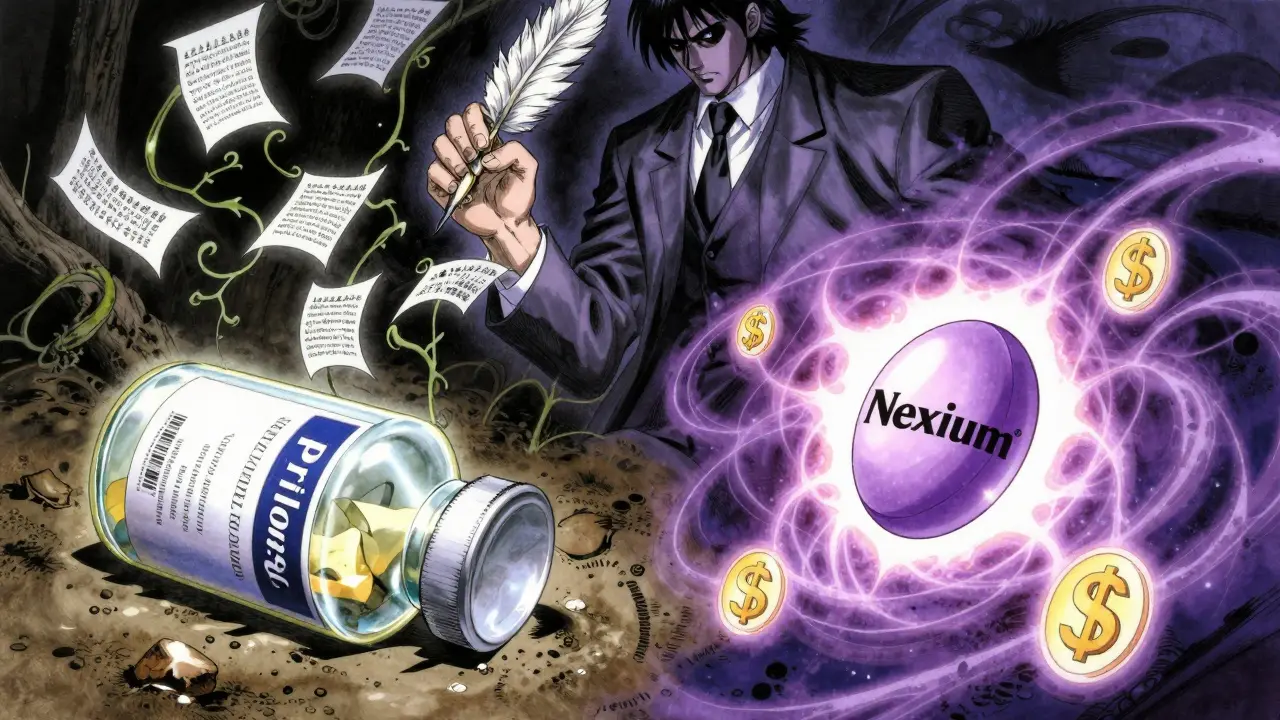
AstraZeneca did this with Prilosec, a heartburn drug. When its patent neared expiration, they launched Nexium - a slightly modified version. Marketing called it "the purple pill," better and stronger. In reality, it was the same active ingredient, just repackaged. Nexium became a $5 billion-a-year drug, while generic Prilosec sat on shelves, legally blocked.
The Humira Example: A Patent Thicket
AbbVie’s Humira, a biologic drug for rheumatoid arthritis and Crohn’s disease, is the most extreme case. Between 2002 and 2022, the company filed 247 patents related to Humira. Over 100 were granted. That’s not innovation. That’s a legal fortress.
Each patent covered something minor: a new injection device, a different storage temperature, a specific dosing schedule. Individually, they seem harmless. Together, they created what experts call a "patent thicket" - a maze of overlapping rights so complex that no generic company could afford to challenge them all in court.
As a result, Humira remained the only option for over a decade. At its peak, it brought in $20 billion a year. That’s about $40 million every single day - all because no generic could get through the patent wall.
Why This Isn’t Innovation
Developing a truly new drug costs around $2.6 billion and takes 10 to 15 years. Evergreening? It costs a few million and takes a couple of years. The return on investment? Often 100x higher.
Harvard researchers found that 78% of new patents on prescription drugs are for existing medications, not new ones. That means most patent activity isn’t driving medical progress. It’s protecting profits.
Real innovation - a drug that cures or significantly improves outcomes - is rare. Evergreening is everywhere. And it’s not just happening in the U.S. It’s a global tactic, used by companies from Europe to Asia to keep prices high everywhere.
The Human Cost
When generics enter the market, prices drop by 80% to 85% within the first year. That’s not theory - it’s data from the FDA and independent studies.
But when evergreening blocks generics, patients are stuck paying hundreds or even thousands of dollars a month for drugs that could cost $20. For someone on a fixed income, that’s not a choice. It’s a life-or-death calculation.
People skip doses. They ration pills. They go without. A 2023 WHO report linked evergreening directly to reduced access to medicines in low- and middle-income countries. But even in the U.S., millions of patients struggle to afford drugs like Humira, Nexium, or insulin - all protected by layers of evergreened patents.
Regulatory Loopholes and Legal Gaps
The 1984 Hatch-Waxman Act was meant to balance innovation and access. It gave brand-name companies 5 years of exclusivity for new drugs, and 3 years for modified versions if they conducted new clinical trials. It also fast-tracked generics.
But it didn’t define what counts as a "new clinical investigation." That’s the loophole. Companies now run tiny, low-quality studies - often just to prove bioequivalence - and call them "essential" to get that 3-year extension. The FDA doesn’t always push back.
And when generic companies do challenge these patents, the legal costs can hit $10 million or more. Most just give up. That’s why only a handful of evergreened drugs ever get challenged in court.
What’s Changing? The Pushback Begins
Pressure is building. In 2022, the U.S. Federal Trade Commission sued AbbVie over Humira’s patent strategy, calling it an "anticompetitive scheme." The case is ongoing, but it’s the first major government action against evergreening.
The Inflation Reduction Act of 2022 gave Medicare the power to negotiate prices for the 10 most expensive drugs. That alone could cut the profit motive behind evergreening. If the government can cap the price, why spend $100 million on 247 patents?
Europe is moving faster. The European Medicines Agency now requires companies to prove a "significant clinical benefit" before granting extra exclusivity for modified drugs. That’s a high bar - and it’s working. Fewer evergreening attempts are succeeding there.
What Comes Next?
Pharma companies aren’t giving up. They’re just getting smarter. New strategies are emerging:
- Supragenerics: Companies launch their own "authorized generics" - cheaper versions they control - to block real generics from entering.
- Pharmacogenomics: Patenting genetic tests that predict who responds to a drug. If you need the test, you need the branded drug.
- Biologics and nanotech: Complex drugs made from living cells are harder to copy. Companies are patenting every step of the process to delay biosimilars for decades.
These aren’t science fiction. They’re happening right now. The next wave of evergreening won’t be about pill colors. It’ll be about DNA, algorithms, and delivery systems.
What You Can Do
As a patient, you’re not powerless. If you’re paying high prices for a drug that’s been on the market for over 10 years, ask your doctor:
- Is there a generic version available?
- Has this drug been evergreened? (Search the name + "patent strategy" online.)
- Is there a cheaper alternative that works just as well?
Advocate. Contact your representatives. Support organizations pushing for patent reform. The system is rigged - but it’s not unbreakable.
Every time a patent expires and a generic enters, someone’s life gets easier. Evergreening delays that moment. And that delay costs lives.
Is evergreening legal?
Yes, for now. Evergreening exploits legal loopholes in patent and drug approval systems. While it’s not technically illegal, regulators and courts are increasingly viewing it as anti-competitive. The U.S. Federal Trade Commission has sued companies like AbbVie over it, and some courts have invalidated patents that lacked genuine innovation. But until laws change, companies will keep using it.
How do I know if my drug has been evergreened?
Check the drug’s history. Look up when the original patent expired and when new ones were granted. Sites like Drugs.com or the FDA’s Orange Book list patent dates. If a drug has multiple patents filed after its first approval - especially for minor changes like dosage or packaging - it’s likely been evergreened. Search "[drug name] evergreening" for investigative reports.
Why don’t generic companies challenge these patents?
Because it’s too expensive and risky. Challenging a single patent can cost $5 million to $10 million. If a company files 10 or 20 patents - like AbbVie did with Humira - the legal battle becomes impossible to win. Most generics simply wait until the last patent expires, even if that means waiting 15 years past the original one.
Does evergreening affect insulin prices?
Yes. Insulin has been heavily evergreened. Companies like Eli Lilly, Novo Nordisk, and Sanofi have filed dozens of patents on reformulations, delivery pens, and combination therapies for insulin products that were first approved in the 1980s and 1990s. This is why, despite being over 100 years old, insulin still costs hundreds of dollars per vial in the U.S., while it’s under $10 in many other countries.
Are there any drugs that weren’t evergreened and became cheap quickly?
Yes. Drugs like Lipitor (atorvastatin) and Plavix (clopidogrel) had strong patent protections but didn’t rely on complex evergreening. When their patents expired, generics flooded the market within months. Prices dropped by over 90%. That’s what happens when companies don’t build legal barriers - and it’s proof that low-cost access is possible.
Nancy Kou
December 20, 2025 AT 02:45Every time I see a $600 insulin prescription, I think about how many people are choosing between food and medicine. This isn’t corporate strategy-it’s systemic cruelty disguised as innovation.
Alex Curran
December 20, 2025 AT 12:48I worked in a clinical trial unit for five years and saw firsthand how pharma reps push these minor reformulations. Doctors often don’t even know the difference between the original and the evergreened version. The marketing is just slick enough to make it seem like progress. It’s terrifying how effective it is.
Danielle Stewart
December 21, 2025 AT 23:19My mom took Humira for years. We paid over $12,000 a month before Medicare finally stepped in. She didn’t care about patents or corporate greed-she just needed to walk without pain. When the generic finally came, she cried. Not because it was new, but because she could breathe again. This system breaks families, not just wallets.
Chris Davidson
December 22, 2025 AT 07:37Patents are meant to incentivize innovation not to create legal loopholes for profit maximization. The fact that 78% of drug patents are on existing drugs proves the system is broken. We need structural reform not band-aid solutions.
Mark Able
December 23, 2025 AT 16:32Wait wait wait-so you’re saying the government should just let generics in and let Big Pharma go bankrupt? That’s insane. Who’s gonna fund the next miracle drug if no one can make money? You think cancer research happens on goodwill?!
mary lizardo
December 24, 2025 AT 10:49It’s not that the system is broken-it’s that you’re emotionally ill-equipped to understand capitalism. If you can’t afford your medication, you shouldn’t be taking it. There are charity programs. There are generics. There are alternatives. This isn’t a moral crisis-it’s a personal responsibility failure.
Andrew Kelly
December 24, 2025 AT 23:16EVERYTHING IS A LIE. The FDA is owned by Big Pharma. The patents? They’re just a distraction. The real goal is to create dependency through psychological manipulation. They’ve been adding fluoride to the water for decades-this is just the next phase. You think insulin is expensive now? Wait till they patent your blood sugar levels.
Hussien SLeiman
December 26, 2025 AT 04:45Let’s be real here. The entire pharmaceutical industry is built on exploiting human desperation. You want innovation? Fine. But don’t call a pill with a different coating a breakthrough. That’s not science-that’s accounting. And the fact that we’ve normalized this as ‘business’ says more about us than it does about them. We’ve turned healthcare into a casino where the house always wins, and the players are dying on the floor. We’re not just complicit-we’re applauding.
mark shortus
December 26, 2025 AT 23:03OKAY SO I JUST READ THIS AND I’M SHAKING. 247 PATENTS ON ONE DRUG?!?!?!? This is the most evil thing I’ve ever heard. I’m not even mad-I’m just… stunned. Like, how do you sleep at night? How do you look in the mirror? I’m going to write my senator. I’m going to protest. I’m going to boycott every single pharma company until this stops. I can’t believe this is real. I can’t believe we let this happen.
Glen Arreglo
December 28, 2025 AT 06:10It’s interesting how this plays out differently in other countries. In Canada, we still pay high prices, but we have price caps. In India, generics are dirt cheap because they don’t respect Western patents. The problem isn’t the science-it’s the legal framework. We need global cooperation, not national band-aids.
Sajith Shams
December 28, 2025 AT 08:11People don’t realize that evergreening is the only reason biologics exist. Without it, biosimilars would wipe out these companies in 5 years. The R&D cost is real. The patents are the only way to recoup it. You want cheap drugs? Then fund public research. Don’t punish companies for trying to survive.
Allison Pannabekcer
December 28, 2025 AT 15:37I’ve been a nurse for 18 years. I’ve seen patients skip doses, cut pills in half, beg for samples. I’ve held people while they cried because they couldn’t afford their insulin. This isn’t about capitalism-it’s about humanity. If we can send people to Mars, we can make sure no one dies because their medicine costs too much.
Marsha Jentzsch
December 29, 2025 AT 05:23I’m so angry I could scream. I lost my brother to kidney failure because he couldn’t afford his immunosuppressants. He was 32. He had a kid. He worked two jobs. He still couldn’t afford the pills. And now I read this and realize it wasn’t an accident-it was a business plan. I’m not just sad. I’m furious. And I’m never quiet about it again.
benchidelle rivera
December 29, 2025 AT 15:57Let’s not pretend this is new. This has been going on since the 1980s. The difference now is that more people are aware. More people are talking. And that’s what scares them. The more we talk, the more pressure builds. The more pressure builds, the more change happens. Keep speaking up. Keep sharing. Keep demanding accountability.
Ryan van Leent
December 30, 2025 AT 20:00So what? Companies make money. That’s how capitalism works. If you can’t afford your meds, get a better job. Stop whining. Everyone else works for it. Why should you get a free pass because you’re too lazy to earn more?