
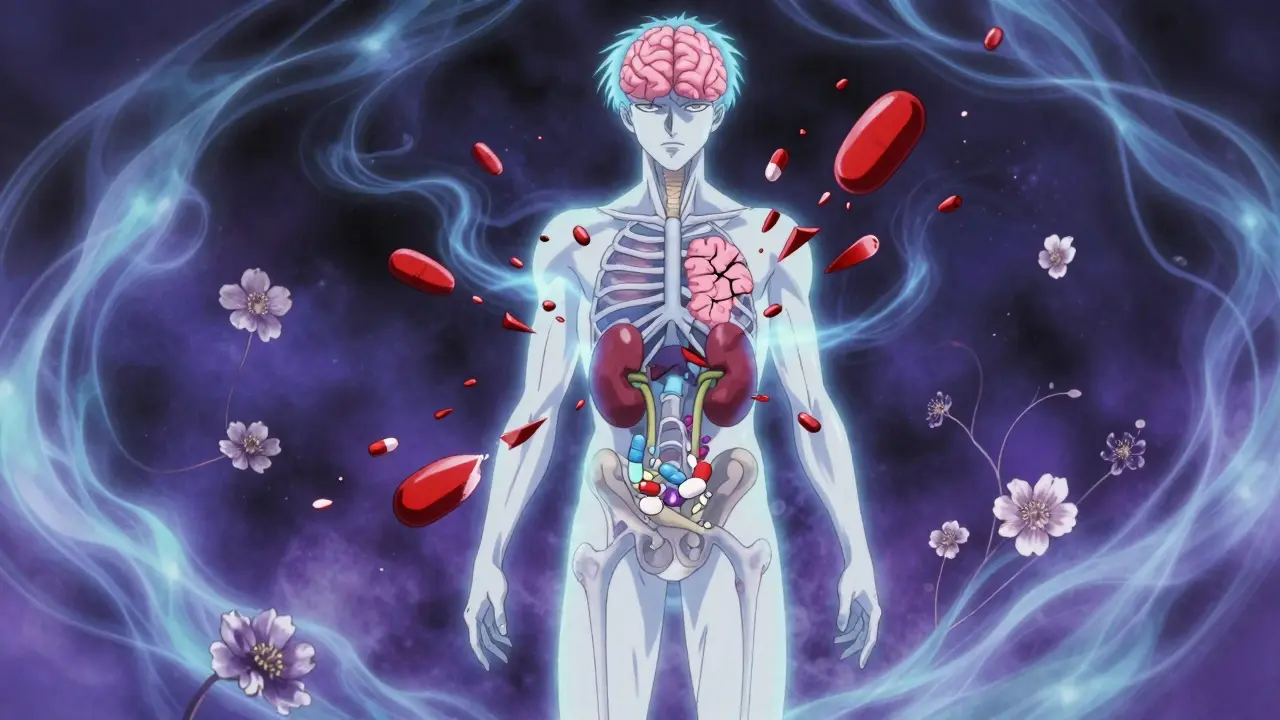
Fluoroquinolone-NSAID Risk Assessment Tool
Assess Your Risk
This tool helps you understand your personal risk when combining fluoroquinolone antibiotics with NSAIDs based on your health factors.
Every year, millions of people take fluoroquinolone antibiotics like ciprofloxacin or levofloxacin for infections - a urinary tract infection, a sinus infection, or even a stubborn bronchitis. At the same time, many of them reach for an over-the-counter NSAID like ibuprofen or naproxen to manage pain or fever. It seems logical. But what many don’t realize is that this common combo can trigger serious, sometimes permanent, damage to the nervous system and kidneys - especially if you’re over 60, have kidney issues, or are taking other medications.
What Are Fluoroquinolones, Really?
Fluoroquinolones are a class of antibiotics that include ciprofloxacin, levofloxacin, moxifloxacin, and ofloxacin. They work against a wide range of bacteria, which is why doctors used to prescribe them for almost anything. But their use has dropped sharply since 2017. Why? Because they don’t just kill bacteria - they can also wreck your body’s own cells.
These drugs interfere with DNA replication in bacteria. But they also mess with human mitochondria - the energy factories inside your cells. That’s why side effects show up in tissues that need a lot of energy: tendons, nerves, kidneys, and the brain. The FDA, Health Canada, and the European Medicines Agency have all issued strong warnings. In 2019, the EMA found 286 cases of disabling side effects lasting 30 days or longer across 21 years in Europe - even though over 300 million daily doses were given out each year.
Patients report symptoms that stick around: tendon pain that never fades, tingling in hands and feet that won’t go away, brain fog that lingers for months. The Fluoroquinolone Effects Research Foundation surveyed over 1,200 people. Nearly 80% said symptoms lasted more than six months. Over a third said they’re permanently disabled.
How Fluoroquinolones Hurt Your Kidneys
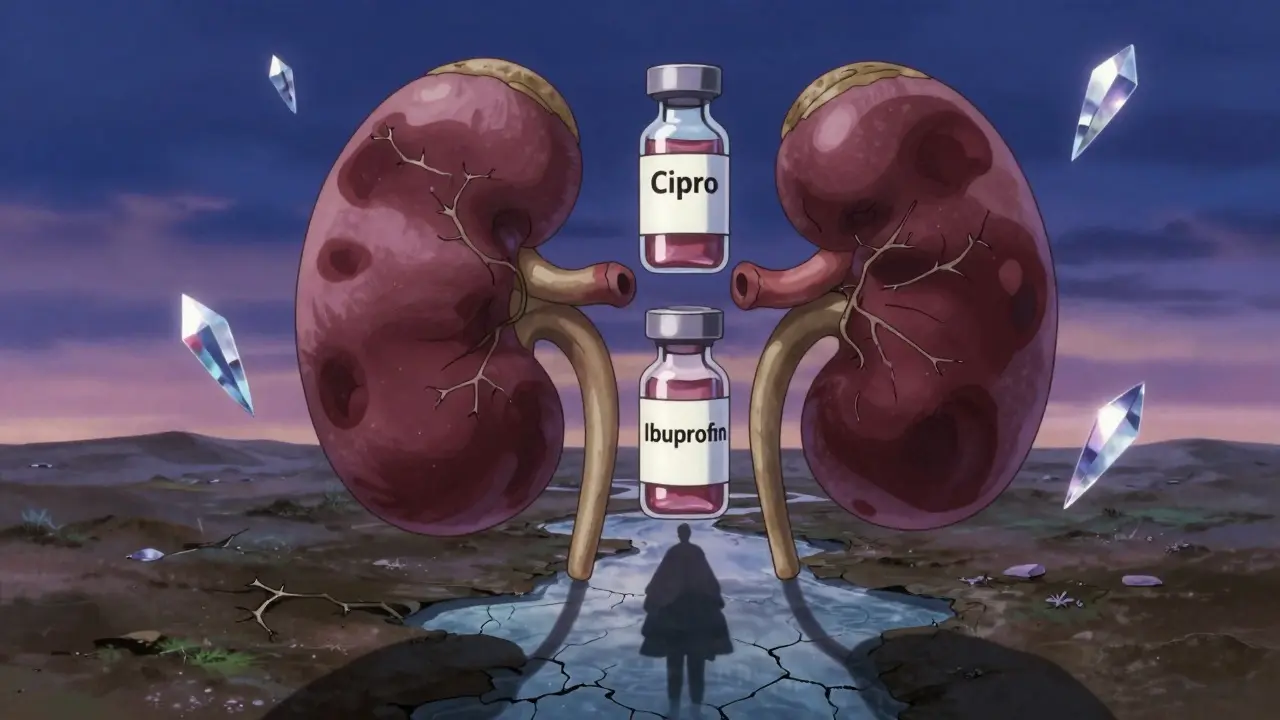
Your kidneys filter your blood 200 times a day. Fluoroquinolones don’t just pass through - they can trigger inflammation inside the kidney tissue. This is called acute interstitial nephritis. It’s not common, but when it happens, it can spike your creatinine levels fast. One study showed that men taking fluoroquinolones had twice the risk of needing hospitalization for acute kidney injury compared to those who didn’t.
Here’s the kicker: fluoroquinolones can also cause crystals to form in urine when it’s too alkaline (pH over 6.8). These crystals can block tiny tubes in the kidneys. Add to that the risk of tubular necrosis - where kidney cells die off - and you’ve got a perfect storm.
And it gets worse. If your kidneys are already weak - say, from diabetes, high blood pressure, or just aging - your body can’t clear the drug efficiently. That means higher drug levels in your blood. For someone with an eGFR between 30 and 59 mL/min/1.73m² (moderate kidney impairment), fluoroquinolone levels can jump 50-100%. That’s not a small change. That’s enough to push you over the edge into toxicity.
NSAIDs and Kidneys: A Silent Threat
NSAIDs like ibuprofen, naproxen, and diclofenac are the go-to for headaches, joint pain, and menstrual cramps. But they’re not harmless. These drugs block prostaglandins - chemicals your kidneys use to keep blood flowing through them. When you take an NSAID, your kidneys get less blood. If you’re dehydrated, on diuretics, or already have kidney disease, this drop in blood flow can cause acute kidney injury.
Studies show that in older adults, NSAIDs alone can raise the risk of kidney failure by 2-3 times. But when you combine them with fluoroquinolones? The risk jumps to 3.5 times higher. That’s not a coincidence. It’s a dangerous synergy. The British National Formulary explicitly warns that using nephrotoxic drugs together - especially fluoroquinolones and NSAIDs - is a red flag.
One case from the UK Yellow Card system tells the story: a 58-year-old man took ciprofloxacin twice daily and ibuprofen three times daily for a UTI. His creatinine shot up from 82 to 287 μmol/L in days. He was hospitalized. Eighteen months later, he still had nerve pain and kidney dysfunction. He wasn’t an outlier. He was a warning.
Neurological Damage: More Than Just Headaches
Most people know NSAIDs can cause dizziness or headaches. But few realize they can trigger aseptic meningitis - inflammation of the brain’s protective lining - especially with ibuprofen and naproxen. It’s rare, but it happens.
Fluoroquinolones? They’re worse. These drugs cross the blood-brain barrier easily. Once inside, they block GABA receptors - your brain’s natural calming signal - and overstimulate NMDA receptors, which excite nerve cells. The result? Confusion, hallucinations, seizures, psychosis, even delirium. Levofloxacin is linked to seizures. Ciprofloxacin often causes brain fog. Ofloxacin? Less neurotoxic, but still risky.
When you combine them? The risk multiplies. If your kidneys aren’t clearing the fluoroquinolone properly, it builds up. NSAIDs can worsen this by reducing blood flow to the brain. And if you’re elderly, diabetic, or on other meds like corticosteroids? Your brain is sitting in a chemical storm.
A 2021 study in the Journal of Clinical Medicine started calling this pattern “Fluoroquinolone-Associated Disability” (FQAD). It’s not just one symptom. It’s a cascade: nerve pain, fatigue, memory loss, anxiety, insomnia, muscle weakness - sometimes lasting years.
Who’s at Highest Risk?
- People over 60 - kidney function drops about 1% per year after 40
- Anyone with eGFR below 60 mL/min/1.73m²
- Patients with epilepsy, Parkinson’s, or prior psychiatric conditions
- Those on diuretics, ACE inhibitors, or other kidney-stressing drugs
- People with dehydration, low blood pressure, or heart failure
Even healthy people aren’t immune. A 45-year-old woman with no prior health issues took ciprofloxacin and naproxen for a bladder infection. Three days later, she couldn’t walk without severe leg pain. Six months later, she still had nerve burning and couldn’t sleep through the night. She wasn’t told about the interaction. She wasn’t warned.

What Should You Do Instead?
If you need an antibiotic and pain relief, here’s what works:
- For UTIs: Skip fluoroquinolones. Nitrofurantoin or fosfomycin are safer first-line options.
- For respiratory infections: Amoxicillin-clavulanate or doxycycline are better choices than levofloxacin.
- For pain: Use acetaminophen (Tylenol) instead of NSAIDs. It doesn’t affect kidney blood flow.
- If you must use NSAIDs: Avoid fluoroquinolones entirely. Talk to your doctor about alternatives.
And if you’ve already taken both? Watch for these signs: sudden swelling in legs, reduced urine output, tingling or burning in hands/feet, confusion, or seizures. Go to the ER. Don’t wait.
Why Are These Drugs Still Prescribed?
Despite the warnings, fluoroquinolones are still used - a lot. In the U.S., prescriptions dropped 22% between 2015 and 2022, but 22 million were still filled in 2022. Why? Because they’re cheap, fast-acting, and familiar. But familiarity doesn’t mean safe.
Doctors aren’t always aware of the latest data. Many still think fluoroquinolones are “stronger” - when in reality, they’re riskier. A 2020 study found fluoroquinolone-related adverse events cost the U.S. healthcare system $1.8 billion annually. Nearly 40% of that was from kidney damage. Nearly 30% from neurological harm.
Regulators are catching up. The FDA plans to update labels in 2026 to include warnings about mitochondrial toxicity - the underlying mechanism behind the long-term damage. That’s a big step. But patients still need to be their own advocates.
Bottom Line
Fluoroquinolones and NSAIDs aren’t just two pills you take together. They’re two forces that can tear at your kidneys and your nervous system. The damage isn’t always immediate. It doesn’t always show up on a blood test. But it can change your life forever.
If you’re prescribed a fluoroquinolone, ask: Is this the only option? If you’re also taking an NSAID, ask: Can I use Tylenol instead? Don’t assume it’s safe because it’s common. The science says otherwise.
Adam Kleinberg
March 12, 2026 AT 10:20Tom Bolt
March 13, 2026 AT 12:46David L. Thomas
March 14, 2026 AT 23:28Mike Winter
March 15, 2026 AT 19:21Randall Walker
March 16, 2026 AT 10:48Miranda Varn-Harper
March 16, 2026 AT 16:08Alexander Erb
March 17, 2026 AT 09:21Donnie DeMarco
March 18, 2026 AT 20:18Shourya Tanay
March 19, 2026 AT 05:44LiV Beau
March 21, 2026 AT 05:11Denise Jordan
March 22, 2026 AT 09:30Gene Forte
March 23, 2026 AT 10:57Kenneth Zieden-Weber
March 23, 2026 AT 11:33Chris Bird
March 23, 2026 AT 20:54