
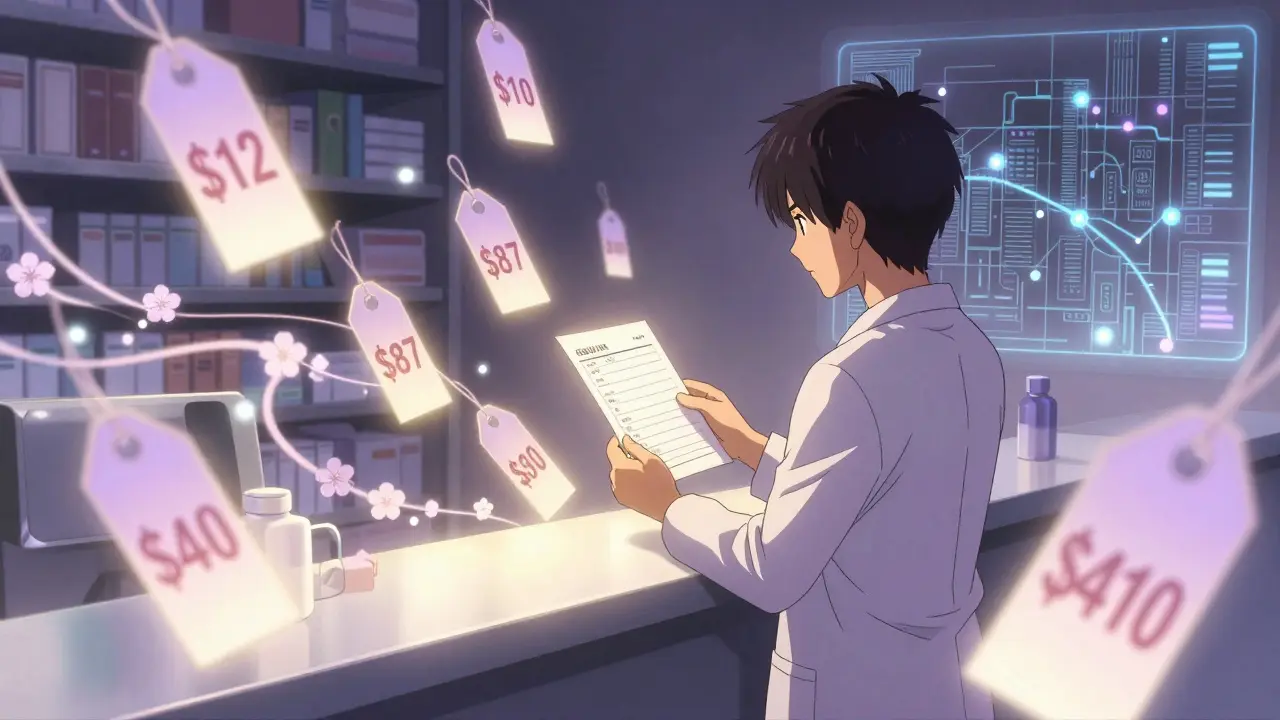
Every year, millions of Americans pay hundreds or even thousands of dollars out of pocket for prescription drugs-sometimes without knowing they could pay far less. The same 30-day supply of metformin might cost $12 at one pharmacy and $87 at another, just down the street. Why? Because drug pricing in the U.S. is broken. But there’s a way to fight back: price transparency tools.
Why Drug Prices Vary So Much
You might think a drug has one price. It doesn’t. There’s the manufacturer’s list price, the negotiated rate between your insurer and the pharmacy, the cash price if you don’t use insurance, and the final amount you actually pay after your deductible and copay kick in. Most people never see the real numbers until they’re standing at the counter with their card ready. A 2023 study by Merative found that for the same medication, prices can differ by more than 500% between pharmacies in the same city. One patient in Texas paid $410 for a 90-day supply of lisinopril at a CVS near them. Five miles away, a Walmart pharmacy offered it for $12. That’s not a typo. That’s the reality. These differences happen because pharmacies negotiate separate deals with insurers and pharmacy benefit managers (PBMs). Without tools to show you those hidden rates, you’re flying blind.What Price Transparency Tools Actually Do
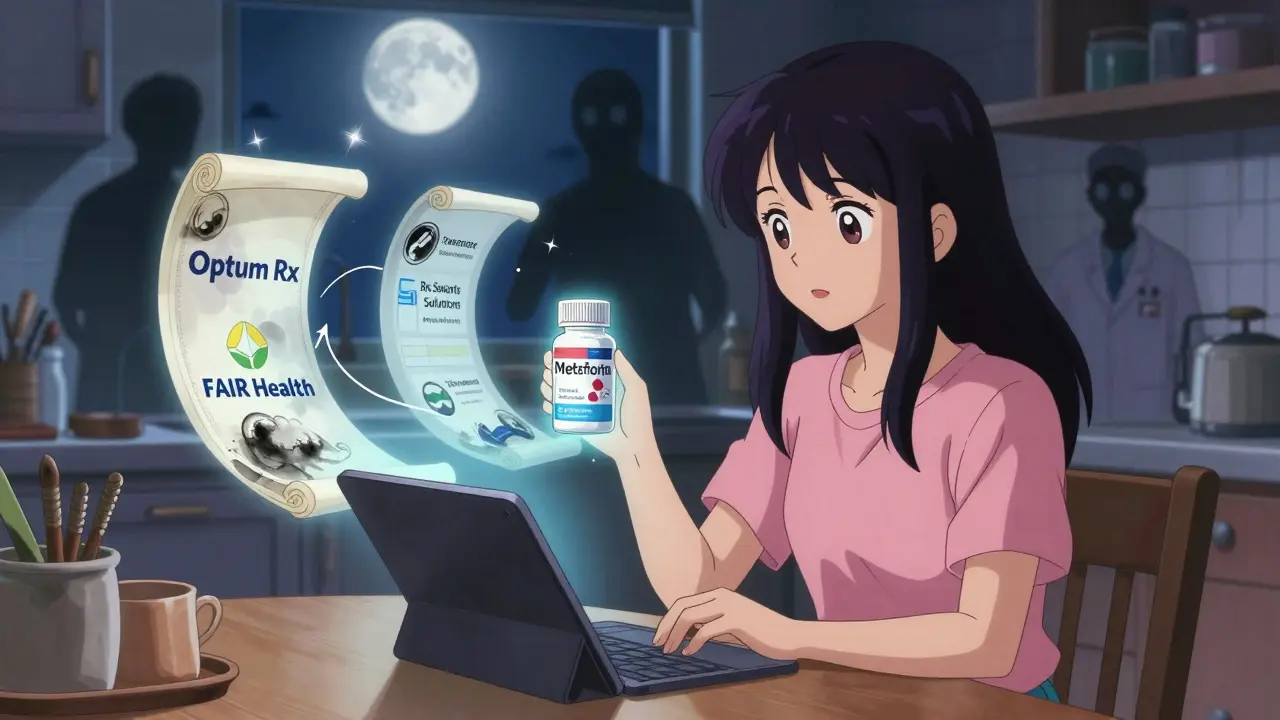
Price transparency tools are websites and apps that pull together real-time pricing data from pharmacies, insurers, and PBMs. They don’t guess. They show what your plan will actually pay-and what you’ll owe. Since January 1, 2024, federal rules require all commercial health insurers to give members access to these tools. That means if you have insurance through your employer or bought a plan on Healthcare.gov, you should already have one built into your insurer’s website or app. Tools like Optum Rx, Rx Savings Solutions, Healthcare Bluebook, and FAIR Health let you search by drug name, dosage, and quantity. Then they show you prices across nearby pharmacies, including cash prices and what your insurance covers. Some even suggest cheaper alternatives that work just as well. For example, if you’re taking a brand-name statin like Lipitor, a tool like Rx Savings Solutions might point you to atorvastatin-the generic version-saving you up to 70% with no loss in effectiveness. That’s not a theory. It’s a fact backed by a 2023 case study showing 83% of users found real savings.Top Tools You Can Use Right Now
You don’t need to be a tech expert. Here are the most reliable tools available in 2026:- Optum Rx: If your insurance is through a large employer (like Walmart, Target, or Amazon), you likely get access via myCompass. Just log in, enter your drug, and compare prices across pharmacies in your area. It’s accurate because it pulls directly from your plan’s negotiated rates.
- Rx Savings Solutions (RxSS): This one stands out because it doesn’t just show prices-it finds lower-cost alternatives and lets you send a request to your pharmacy to switch your prescription. Used by 18 of the top 25 PBMs, it’s the most effective pharmacy-specific tool according to the Commonwealth Fund.
- FAIR Health Consumer: No insurance login needed. Just go to fairhealthconsumer.org, type in your drug, and see what people in your zip code paid last month. Great for cash-paying patients or those without insurance.
- Healthcare Bluebook: Best for medical procedures, but also covers over 4,000 prescriptions. Shows a "Fair Price™" benchmark so you know if you’re being overcharged. Downloaded over 250,000 times.
- Turquoise Health: More advanced. Lets you filter by payer, pharmacy type, and even see what hospitals and clinics are charging. Used by 45% of large hospital systems.
Most of these tools have mobile apps. You can check prices while you’re at the grocery store or waiting in line at the pharmacy.
How to Use Them (Step by Step)
You don’t need to be a data analyst. Here’s how to get real savings in five steps:- Check if your insurer has a tool. Log into your insurance portal. Look for "Drug Pricing," "Cost Estimator," or "Price Comparison." If you’re not sure, call your plan’s customer service. About 78% of large employers now offer this.
- Enter your exact drug details. Don’t just type "blood pressure medicine." Type the full name: "amlodipine 10 mg tablet." Include the quantity-30 vs. 90 days can change the price.
- Compare all options. Look at prices at CVS, Walgreens, Walmart, Costco, and local independents. Some tools even show mail-order options. Pay attention to the "Your Cost" column, not the list price.
- Ask about alternatives. If the tool suggests a generic or therapeutic substitute, ask your doctor if it’s okay. Many patients don’t realize generics are just as effective.
- Call the pharmacy before you go. Tools aren’t perfect. Insurance claims can be delayed, or a pharmacy might not update prices right away. Always confirm the final price before picking up.
First-time users take about 15-20 minutes. After three uses, most people cut that down to under 7 minutes. That’s less time than waiting for a prescription to fill.
What They Don’t Tell You
These tools are powerful-but they’re not magic. Here are the hidden flaws:- They don’t always include GoodRx coupons. A Consumer Reports investigation in December 2023 found that some tools ignored discount programs that could save users even more.
- They show list prices, not your actual cost. Dr. Karen Van Nuys from USC points out that many tools display the drug’s manufacturer price instead of what your insurance negotiated. That’s misleading. Always look for "Your Out-of-Pocket Cost."
- Some don’t work with specialty drugs. Medications for cancer, MS, or rheumatoid arthritis often require prior authorization. These tools might not show accurate prices until the insurance approval is done.
- Not all pharmacies comply. Only 62% of imaging centers and some smaller pharmacies still don’t report prices accurately. If a tool says "price not available," call the pharmacy directly.
Also, don’t assume your insurance plan’s tool is the only option. Use FAIR Health or GoodRx as a backup. Cross-checking gives you the clearest picture.

Real People, Real Savings
People are using these tools-and saving big. - One Reddit user, u/MedSaver2023, saved $287 on a 90-day supply of apixaban by switching from a local pharmacy to a CVS that offered a lower negotiated rate. - Another user, BudgetPharma, cut their annual medication bill from $1,850 to $620 by using Optum Rx to find cheaper alternatives and bulk discounts. - A Kaiser Health News report shared how a patient found an MRI quote of $4,200-and discovered the same scan was $450 at a nearby imaging center using Healthcare Bluebook. These aren’t outliers. They’re proof that knowledge equals power.What’s Coming Next
The rules are changing fast. By 2026, experts predict 90% of prescription purchases will involve price comparison tools. The industry is projected to hit $3.8 billion in value by 2028. New features are rolling out:- AI tools that predict your future drug costs based on your usage.
- Integration of quality scores with pricing-so you can see not just how much, but how well a pharmacy fills prescriptions.
- Blockchain systems to verify that prices are accurate and up to date.
And Congress is considering the Fair Accountability and Innovative Research Drug Pricing Act, which would force manufacturers to report price hikes on drugs costing more than $100 a month. That could bring even more clarity.
Don’t Just Pay-Compare
You wouldn’t buy a car without checking prices at three dealerships. Why do it with your medication? Price transparency tools are free. They’re legal. They’re required by law. And they work. Start today. Open your insurance app. Type in your most expensive prescription. Look at the options. Call one pharmacy. You might be surprised. It’s not about being cheap. It’s about being smart. And in a system that’s stacked against you, that’s the only edge you’ve got.Are price transparency tools free to use?
Yes, all federally mandated price transparency tools are free for patients. Whether it’s through your insurer’s website, FAIR Health, or Rx Savings Solutions, there’s no charge to search, compare, or get cost estimates. Some tools may offer premium features, but the core pricing data is always free.
Can I use these tools if I don’t have insurance?
Absolutely. Tools like FAIR Health and GoodRx don’t require insurance. They show cash prices, which are often lower than insurance rates-especially for generics. Many pharmacies offer discount programs for uninsured patients, and these tools help you find the best deal.
Why does the price on the tool differ from what I paid at the pharmacy?
There are a few reasons. Your insurance claim might not have processed yet, or the pharmacy hasn’t updated its pricing feed. Sometimes, the tool shows a list price instead of your actual out-of-pocket cost. Always confirm the final price with the pharmacist before leaving the counter.
Do these tools work for specialty medications?
Some do, but not all. Specialty drugs often require prior authorization, step therapy, or are only available through specific pharmacies. Tools like Rx Savings Solutions can still suggest alternatives, but you may need to contact your pharmacy or insurer directly for exact pricing.
Can I trust the suggestions for cheaper drug alternatives?
Yes, if they’re from reputable tools like Rx Savings Solutions or Optum Rx. These platforms use clinical guidelines and FDA-approved therapeutic equivalents. Always talk to your doctor before switching, but the suggestions are based on proven, safe alternatives-not random substitutions.
How often should I check drug prices?
Check every time you refill, especially if your insurance plan changes or you move to a new pharmacy. Prices shift frequently-sometimes monthly. Even small changes can add up to hundreds in savings over a year.
Are these tools only for people with employer insurance?
No. Anyone with commercial insurance-whether bought through Healthcare.gov, Medicare Advantage, or a spouse’s plan-has access. Even Medicare Part D beneficiaries can use tools like FAIR Health or GoodRx to compare costs across pharmacies.
What if my pharmacy says the tool’s price is wrong?
Ask them to check their system again or call their corporate pharmacy support. Sometimes, pricing feeds lag. If they still say it’s wrong, ask for the exact breakdown: what’s the negotiated rate? What’s your copay? What’s the deductible? Write it down. You’re entitled to that information.
lisa Bajram
January 10, 2026 AT 02:24OMG I just used Optum Rx and saved $212 on my metformin-like, I literally cried in the pharmacy aisle. Why didn’t anyone tell me this sooner??
Dwayne Dickson
January 10, 2026 AT 03:00While the utility of price transparency platforms is indisputable, one must acknowledge the structural inefficiencies inherent in the PBM-mediated reimbursement ecosystem, which continue to obfuscate true cost dynamics despite regulatory mandates.
Jake Nunez
January 10, 2026 AT 04:19FAIR Health is my go-to. No login, no BS. Just type in the drug and see what people actually paid. Works even when your insurance app glitches.
Jaqueline santos bau
January 11, 2026 AT 04:38Wait so you’re telling me I’ve been overpaying for my blood pressure meds for THREE YEARS?? I feel like such a fool. And now I’m mad. So mad. Like, I’m gonna text my doctor right now and demand a switch. This is outrageous.
Kunal Majumder
January 11, 2026 AT 17:24I’m from India and we don’t have this luxury. But I’ve seen friends in the US use these tools. It’s wild how much you can save. Even if you’re not rich, you deserve to not get robbed by pharmacies.
Aurora Memo
January 12, 2026 AT 08:20I’ve been using Rx Savings Solutions for six months now. It’s not perfect, but it’s made a real difference. I always double-check with my pharmacist though. Small things add up.
chandra tan
January 12, 2026 AT 16:18My cousin in Delhi would kill for this. Here, you just pay what the shop says. No comparisons. No transparency. Just hope you’re not getting ripped off.
Ted Conerly
January 13, 2026 AT 02:39Just tried Healthcare Bluebook for my statin. Found a local pharmacy that was $87 cheaper than my usual one. Went there, paid cash, saved $200. Best 5 minutes of my week. Do it. Just do it.
Faith Edwards
January 14, 2026 AT 00:53It’s frankly appalling that patients must become amateur pharmacoeconomists just to afford basic medications. The fact that this is even necessary speaks volumes about the moral bankruptcy of our healthcare infrastructure.
Jay Amparo
January 14, 2026 AT 13:21Man, I used to think I was bad with money until I saw how much I was wasting on prescriptions. Now I check every refill. I’ve saved over $1,200 in a year. Not bad for a guy who just clicks a few buttons.
Lisa Cozad
January 15, 2026 AT 05:41My mom just found out she was paying $90 for a generic that costs $14 at Costco. She’s not tech-savvy at all. I walked her through it. She cried again. We’re both so relieved.
Saumya Roy Chaudhuri
January 15, 2026 AT 05:51Most people don’t even know how to read the difference between list price and out-of-pocket. You need a degree in healthcare finance to use these tools properly. And even then, half the time the data’s outdated. It’s a mess.
Ian Cheung
January 15, 2026 AT 14:54Just checked my insulin and saved $180. I’m not even joking. I’m gonna tell my whole family. Everyone needs to know this. No one should have to choose between food and meds