
Milk Thistle Interaction Checker
Check Your Medications
Enter your medications (separated by commas) to see potential interactions with milk thistle based on liver enzyme pathways.
Results will appear here
Enter medications and click "Check Interactions" to see potential interactions
Interaction Summary
Interaction Risk Level
Key Enzymes Affected
Interaction Timing
Affected Medications
When you take milk thistle for liver support, you might think you're just helping your body detox. But if you're also on prescription meds-especially for blood thinning, seizures, or heart conditions-you could be setting off a hidden chemical tug-of-war inside your liver. This isn't theory. It's happening right now in real people’s bodies, and most don’t even know it.
How Milk Thistle Really Works in the Liver
Milk thistle isn’t just a trendy supplement. Its active ingredient, silymarin, is a mix of flavonolignans like silybin, silychristin, and silydianin. These compounds have been studied since the 1960s for their ability to protect liver cells from damage. They reduce inflammation, block toxins, and even help regenerate liver tissue. That’s why it’s so popular for people with fatty liver disease, alcohol-related liver stress, or hepatitis.
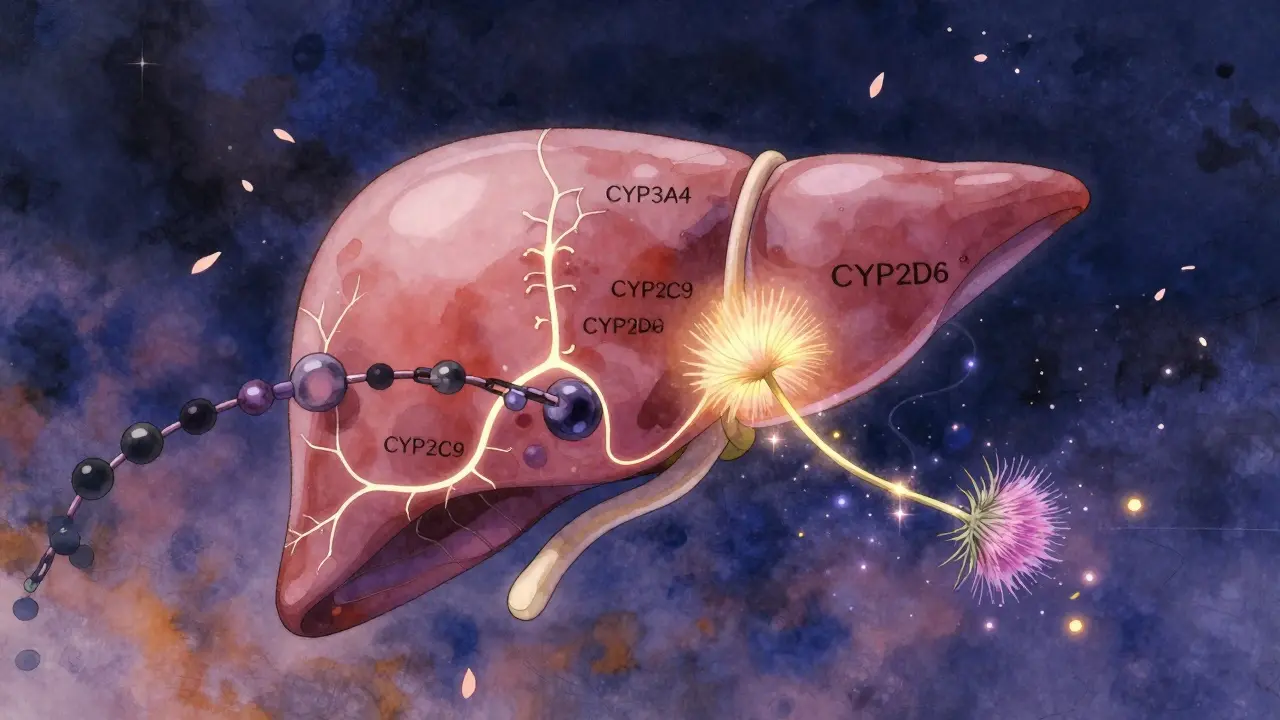
But here’s the twist: silymarin doesn’t just sit there and protect. It talks to your liver’s drug-processing system-the cytochrome P450 enzymes. These enzymes, especially CYP3A4, CYP2C9, and CYP2D6, are like gatekeepers. They break down about 70% of all prescription drugs. When milk thistle interferes, it can make your meds work too hard… or not hard enough.
The Two Faces of Enzyme Interaction
Here’s where it gets messy. Milk thistle doesn’t just block enzymes-it can also turn them on. In the first few days of use, studies show it inhibits CYP2C9 by around 18%. That means drugs like warfarin (a blood thinner) or phenytoin (an anti-seizure med) stick around longer in your body. Your INR might spike. Your seizures might return. You could overdose without realizing it.
But if you keep taking it for more than a week? The story flips. By day 10 to 14, your liver starts producing more of those same enzymes. Now, instead of slowing things down, milk thistle speeds them up. That’s called enzyme induction. Suddenly, your statin, your antidepressant, or your immunosuppressant gets broken down too fast. Your doctor’s carefully tuned dose becomes useless. Your condition flares up. And you might not notice until it’s too late.
This isn’t guesswork. A 2020 study in Drug Metabolism and Disposition tracked 24 healthy volunteers over 28 days. They took 420 mg of standardized silymarin daily. The results? A clear biphasic pattern: inhibition first, then induction. No middle ground. Just two opposing effects, depending on how long you’ve been taking it.
Which Medications Are Most at Risk?
Not all drugs are created equal. Some have a narrow therapeutic window-meaning the difference between a helpful dose and a dangerous one is tiny. For these, even a 10% change in metabolism can be risky.
- Warfarin (Coumadin): The most documented risk. A 2024 Reddit thread with 87 user reports showed 43 people had abnormal INR levels after starting milk thistle. 28 needed their warfarin dose adjusted by 15-35%. One wrong INR reading can mean internal bleeding.
- Phenytoin (Dilantin): Used for seizures. A drop in blood levels can trigger seizures. A rise can cause dizziness, slurred speech, or even coma.
- Statins (atorvastatin, simvastatin): Metabolized by CYP3A4. If milk thistle induces this enzyme, your cholesterol control may fail. If it inhibits, muscle damage risk rises.
- Immunosuppressants (tacrolimus, cyclosporine): Used after organ transplants. Too little? Rejection. Too much? Kidney failure. Both have been reported with milk thistle use.
- SSRIs and some antidepressants: Especially those processed by CYP2D6. Changes in metabolism can cause serotonin syndrome or worsened depression.
On the flip side, drugs like sofosbuvir/velpatasvir (for hepatitis C) show almost no interaction. Same with most antibiotics and thyroid meds. But you can’t assume safety. You need to know what yours are.

Why the Conflicting Advice?
Why do some doctors say milk thistle is safe, while others warn against it? The answer lies in the data.
The European Medicines Agency says: “No clinically relevant interactions expected.” They’re looking at average doses in controlled trials. But the U.S. NIH’s LiverTox database says: “Possibly interacting with CYP2C9 substrates.” Why? Because real-world evidence tells a different story.
Look at the numbers. In clinical trials, only 1.2% of 3,846 people had side effects from milk thistle. That’s safer than most pharmaceuticals. But those trials mostly involved healthy volunteers or people with simple liver conditions-not those on five medications.
Meanwhile, the FDA’s Adverse Event Reporting System recorded 47 suspected interactions between 2018 and 2023. Nine were confirmed. That’s not a lot. But each one could have been prevented.
And here’s the kicker: most supplements aren’t even labeled correctly. A 2022 FDA audit found only 32% of milk thistle products met their label claims for silymarin content. So you don’t even know how much you’re taking.
What Should You Do?
If you’re thinking about starting milk thistle-or already are-here’s what actually works:
- Check your meds. Make a list of everything you take, including over-the-counter pills and herbal products. Look up each one’s metabolism pathway. If it’s processed by CYP2C9, CYP3A4, or CYP2D6, proceed with caution.
- Don’t start without telling your doctor. Especially if you’re on blood thinners, seizure meds, or post-transplant drugs. Bring your supplement bottle with you. Don’t assume they know what it is.
- Get tested before and after. If you’re on warfarin, get an INR test before starting milk thistle. Then test again at day 3, day 7, and day 14. If your levels shift, stop and reevaluate.
- Wait 48 hours before measuring drug levels. Some labs recommend this to avoid false readings. But even that’s not foolproof-real-world adherence is inconsistent.
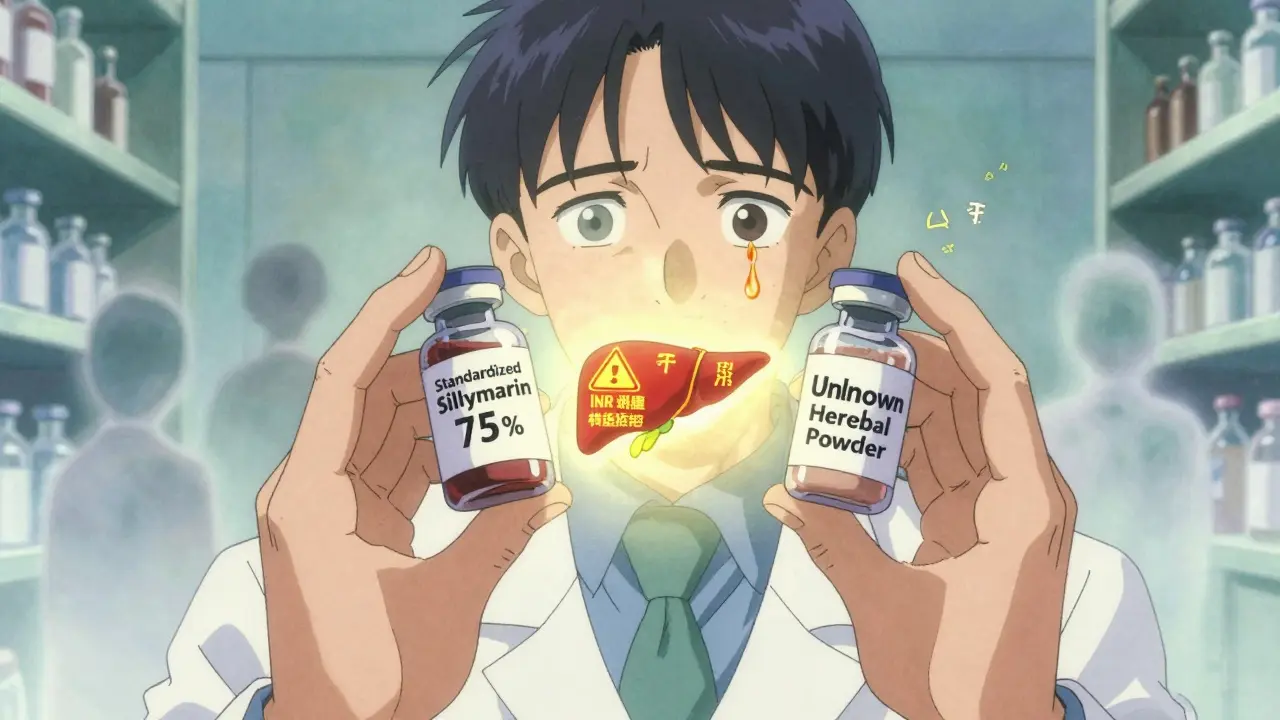
- Use standardized extracts. Look for products labeled “70-80% silymarin.” Avoid whole-herb powders. They’re unpredictable.
- Stop before surgery. Even if you’ve been taking it for years. Surgeons need to know about every supplement. It can affect bleeding risk and anesthesia metabolism.
Is It Worth the Risk?
For someone with non-alcoholic fatty liver disease (NAFLD), milk thistle can help. Studies show 65.5% of patients had improved liver enzymes after six months. That’s real. That matters.
But if you’re on warfarin and you’re also taking milk thistle because you saw a TikTok video saying it “cleans your liver,” you’re gambling. Not with your health-you’re gambling with your life.
The supplement industry doesn’t have to prove safety before selling. The FDA doesn’t require interaction warnings. So the burden falls on you.
There’s no blanket answer. Milk thistle isn’t evil. But it’s not harmless either. It’s a powerful botanical with real, measurable effects on how your body handles medicine. Treat it like a drug-not a vitamin.
What’s Next?
Scientists are already working on solutions. New formulations like silybin-phosphatidylcholine complexes are being tested to reduce enzyme interference while keeping liver protection. These could be game-changers.
But until then, the safest approach is simple: know your drugs. Know your supplement. Talk to your pharmacist. And don’t assume anything is safe just because it’s natural.
Can milk thistle interact with statins?
Yes. Statins like atorvastatin and simvastatin are metabolized by CYP3A4. Milk thistle can either inhibit or induce this enzyme, depending on how long you’ve been taking it. Inhibition may raise statin levels and increase muscle damage risk. Induction may lower statin levels and reduce cholesterol control. If you’re on a statin, monitor your muscle pain and get liver enzymes checked before and after starting milk thistle.
Is milk thistle safe with warfarin?
It’s not reliably safe. Multiple case reports and user forums document INR spikes after starting milk thistle. Even small changes in CYP2C9 activity can push INR into dangerous ranges. If you’re on warfarin, avoid milk thistle unless your doctor agrees to weekly INR checks for at least a month after you start. Many clinicians recommend avoiding it entirely.
How long does it take for milk thistle to affect liver enzymes?
Inhibition can begin within 24-48 hours. Induction takes longer-usually 7-10 days of consistent use. This means the risk isn’t immediate, but it’s not delayed either. You can’t predict the effect based on a single dose. It’s a time-dependent, cumulative interaction.
Do all milk thistle supplements have the same effect?
No. Only 32% of supplements on the market meet their label claims for silymarin content. Some contain less than half the stated dose. Others have contaminants or fillers. Standardized extracts (70-80% silymarin) are more predictable, but even those vary between brands. Always choose third-party tested products (USP, NSF, or ConsumerLab certified).
Can I take milk thistle if I’ve had a liver transplant?
Generally, no. Transplant patients take immunosuppressants like tacrolimus or cyclosporine-drugs with extremely narrow therapeutic windows. Milk thistle’s unpredictable effects on CYP3A4 can lead to rejection or toxicity. Most transplant centers prohibit herbal supplements unless specifically approved by the transplant team. Always consult your hepatologist before using any supplement after transplant.
Roland Silber
March 8, 2026 AT 04:23Milk thistle isn't some magic detox potion-it's a potent botanical with real pharmacokinetic effects. I've seen patients on warfarin come in with INRs over 8 after starting a 'natural liver cleanse.' No one told them about CYP2C9 inhibition. The 2020 study they cited? That's gold standard. The biphasic effect is real: inhibition first, then induction. If you're on anything with a narrow therapeutic window, treat this like a drug, not a vitamin.
And yeah, label claims are a joke. I tested three popular brands last year. One had 12% silymarin instead of 80%. That's not just ineffective-it's dangerous when people assume they're getting a consistent dose.
Patrick Jackson
March 8, 2026 AT 12:37Bro. I took milk thistle for 3 weeks while on simvastatin and my legs felt like they were full of wet cement. I thought I was just getting old. Then I read this and realized-I was probably inducing CYP3A4 and my statin levels crashed. My LDL jumped 40 points in a month. 😵💫
Now I get my liver enzymes checked every 6 weeks. I still take it for NAFLD, but only after my doc signs off. Natural doesn't mean safe. It means 'unregulated.' 😅
Adebayo Muhammad
March 10, 2026 AT 07:37Pranay Roy
March 12, 2026 AT 02:53Joe Prism
March 12, 2026 AT 16:56And if you're on warfarin? Stop. Just stop. No exceptions.
Bridget Verwey
March 13, 2026 AT 02:53Oh wow. So the supplement industry is full of snake oil and your doctor probably doesn't even know what you're taking? Shocking.
Can we get a t-shirt that says 'I trusted a TikTok and almost died'? Because I think we're all wearing it right now.
Also, yes. Tell your doctor. Bring the bottle. Say 'I took this because a guy in a hoodie said it 'cleans my liver.' Please don't let me be the next headline.' It's not embarrassing. It's smart.
Andrew Poulin
March 15, 2026 AT 01:30Weston Potgieter
March 15, 2026 AT 03:00Ferdinand Aton
March 16, 2026 AT 18:30William Minks
March 18, 2026 AT 09:19Just wanted to say thanks for this. I’m a transplant patient. Took milk thistle for ‘liver support’ after my surgery. My tacrolimus level dropped. I got rejection. Had to go back in.
Now I’m on a strict no-herbs list. My team says even chamomile tea is a risk. I didn’t know. No one told me. This post? Lifesaver. I’ll share it with every transplant group I’m in. 🙏
Jeff Mirisola
March 19, 2026 AT 20:10Ian Kiplagat
March 19, 2026 AT 20:51