
Osteoporosis Risk Calculator
Calculate Your Bone Loss Risk
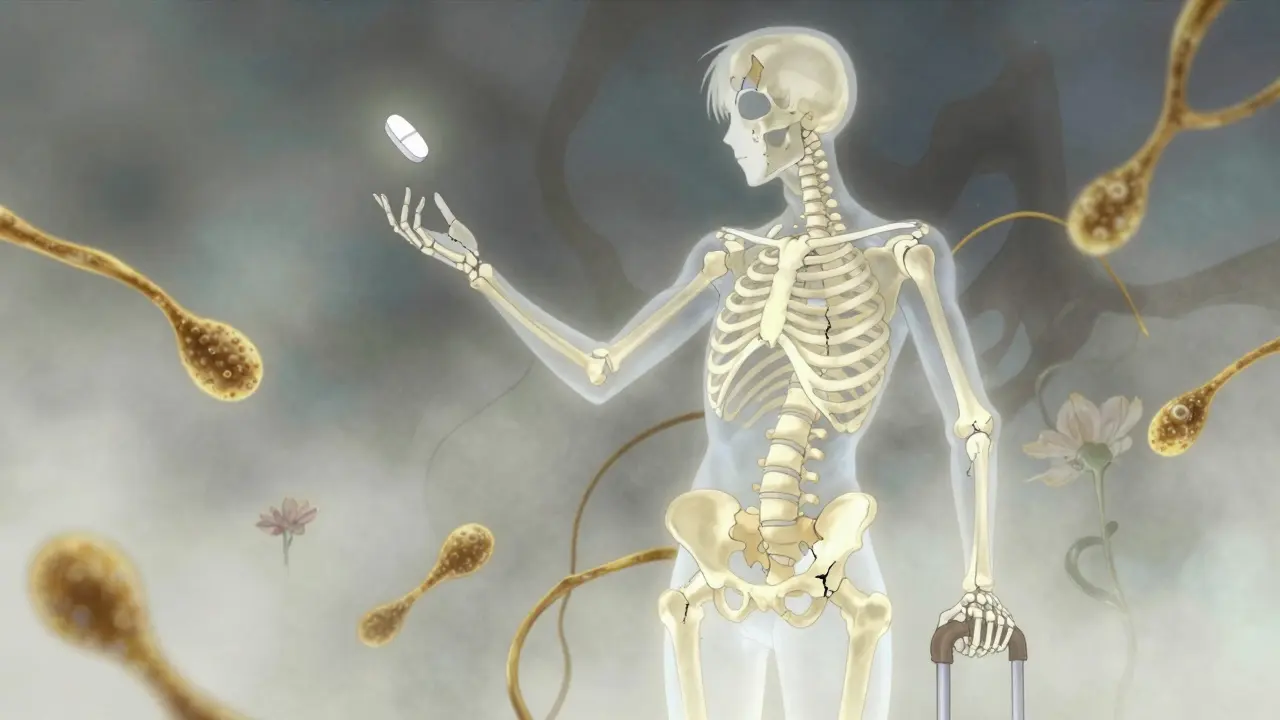
When you’re on long-term corticosteroids-whether for rheumatoid arthritis, lupus, asthma, or another chronic condition-you’re not just managing your main illness. You’re also quietly putting your bones at risk. Glucocorticoid-induced osteoporosis (GIOP) is the most common form of secondary osteoporosis, and it happens faster than most people realize. Within just 3 to 6 months of starting daily prednisone at 2.5 mg or more, bone density can drop by 5% to 15%, especially in the spine. Fracture risk jumps by 70% to 100% in that same window. This isn’t a slow, distant threat. It’s a ticking clock, and the first 6 months are the most critical.
How Corticosteroids Attack Your Bones
Corticosteroids don’t just reduce inflammation-they disrupt the natural balance of bone building and breakdown. They shut down osteoblasts, the cells that make new bone, and speed up osteocyte death, which weakens the bone’s internal structure. At the same time, they keep osteoclasts-cells that break down bone-alive longer than they should. The result? Bone loss outpaces bone repair.
It’s not just about cell activity. Corticosteroids also mess with your body’s calcium handling. They cut intestinal calcium absorption by about 30%, so even if you eat dairy or take supplements, your body absorbs less. They also make your kidneys dump more calcium into urine instead of holding onto it. And they blunt your bones’ response to physical stress. Weight-bearing exercise helps strengthen bones-but in steroid users, that benefit drops by up to 25%.
Every extra milligram of prednisone you take per day makes it worse. Studies show that for each 1 mg increase in daily prednisone equivalent, you lose 1.4% of bone density in your spine each year and 0.9% in your hip. A person on 10 mg/day is losing bone at a rate similar to someone 10 to 15 years older.
Who’s at Risk-and How to Know
If you’re taking 2.5 mg or more of prednisone (or its equivalent) daily for 3 months or longer, you’re in the high-risk group. That’s not a suggestion-it’s a clinical threshold backed by the Bone, Body and Calcium working group and the American College of Rheumatology. The risk doubles if you’re on 7.5 mg or more.
But not everyone gets tested. Only 31% of long-term steroid users have had a bone density scan (DXA), even though guidelines say you should get one at the start of therapy and every 1 to 2 years after. And only 40% have documentation of calcium supplementation, while 37% have vitamin D records. That means over half of people on these drugs aren’t getting the most basic protections.
Gender plays a role too. Women are more likely to be screened and treated-76% receive some form of intervention, compared to just 44% of men. That’s a gap that needs closing. Men on steroids are just as vulnerable, but they’re far less likely to be monitored.
Non-Drug Prevention: The Foundation
No medication can replace the basics. The first rule? Use the lowest dose possible for the shortest time. Reducing your daily dose from over 7.5 mg to 7.5 mg or less cuts fracture risk by 35% within six months. That’s not minor-it’s massive.
Next, move your body. Aim for at least 30 minutes of weight-bearing activity on most days. Walking, stair climbing, resistance training-these aren’t optional. They’re your first line of defense. Even light activity helps, but the key is consistency. Don’t wait until you feel weak to start.
Smoking and alcohol make things worse. Quitting smoking reduces fracture risk by 25% to 30%. Limit alcohol to fewer than 3 units per day. One unit is roughly a small glass of wine or half a pint of beer. More than that? You’re adding another layer of bone damage.
And yes-sunlight matters. Your skin makes vitamin D from sunlight. If you’re indoors most of the day or live in a northern climate, you’re likely deficient. That’s why supplementation isn’t optional.
Calcium and Vitamin D: The Non-Negotiables
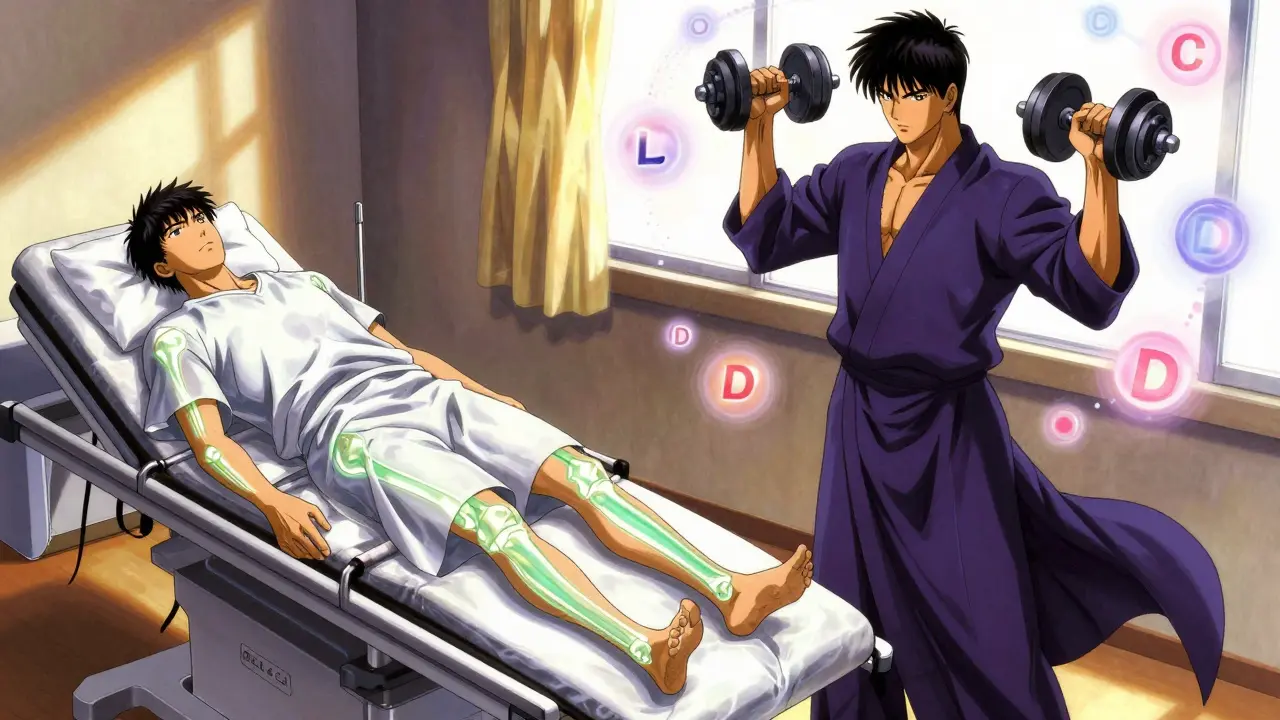
Every patient on long-term corticosteroids needs calcium and vitamin D. No exceptions. The target? 1,000 to 1,200 mg of calcium daily. Try to get most of it from food-yogurt, cheese, leafy greens, fortified plant milks. But if you can’t reach that number through diet alone, supplement the rest.
For vitamin D, aim for 600 to 800 IU daily. Some people need up to 1,000 IU to keep blood levels above 20 ng/mL. That’s the minimum threshold for bone health. Studies show that taking 1,000 mg calcium plus 500 IU vitamin D daily prevents bone loss in the spine by 0.72% per year. Without it, people lose 2% per year. That’s a 2.7% difference in annual bone loss-enough to change your fracture risk over time.
Don’t assume your multivitamin is enough. Most have only 400 IU of vitamin D. You likely need more. Talk to your doctor about a blood test to check your 25-hydroxyvitamin D level. It’s simple, cheap, and tells you exactly what you need.
Medications That Work
If you’re at moderate or high risk-based on your dose, age, prior fractures, or low bone density-then medication is next. Bisphosphonates are the first-line choice. Risedronate (5 mg daily or 35 mg weekly) reduces vertebral fractures by 70% and non-vertebral fractures by 41%. Alendronate works too, but risedronate has the strongest evidence in steroid users.
For those who can’t take oral bisphosphonates (due to stomach issues or difficulty swallowing), zoledronic acid is an option. One IV infusion per year increases spine bone density by 4.5% in 12 months, compared to just 0.5% in untreated patients.
Denosumab (60 mg every 6 months) is another strong option. It boosts spine BMD by 7% in a year. But it requires strict adherence. If you miss a dose, bone loss can accelerate quickly.
For people with very low bone density (T-score ≤ -2.5) or prior fractures, teriparatide is the most powerful tool. This daily injection increases spine BMD by 9.1% in 12 months-more than double what bisphosphonates achieve. It’s not first-line for everyone, but for high-risk patients, it’s life-changing.
Why So Many People Are Left Behind
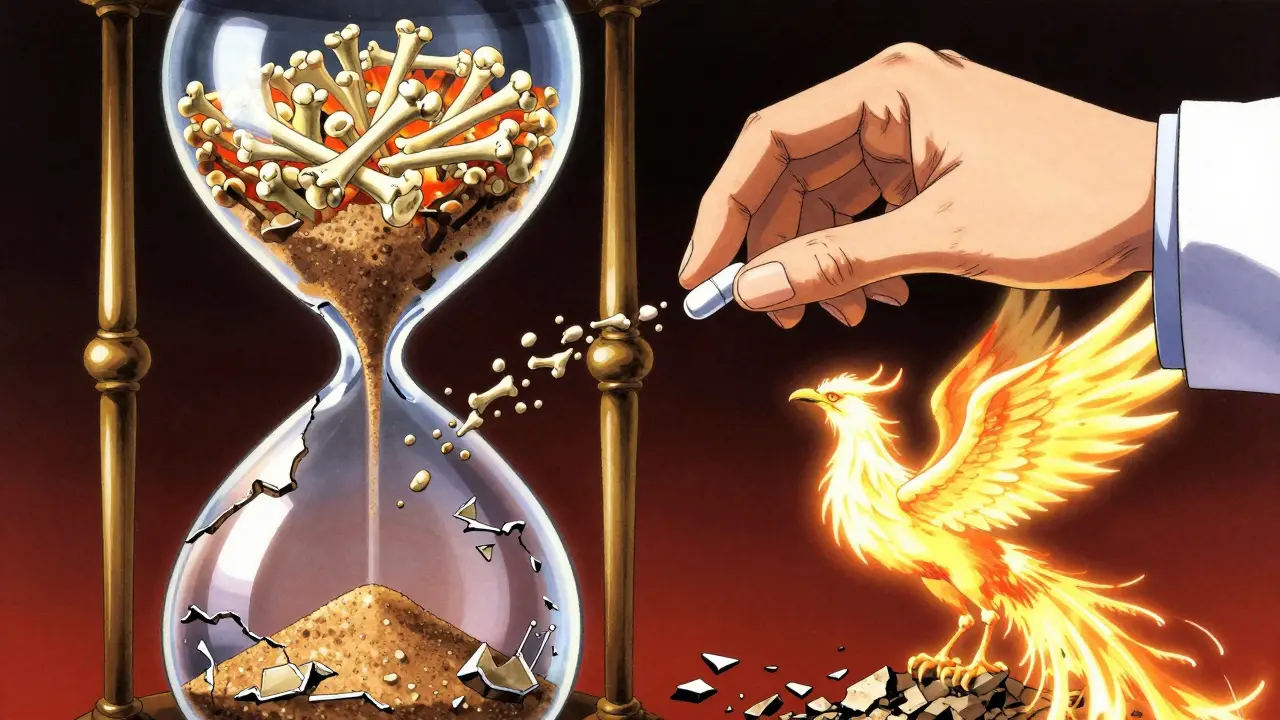
Here’s the hard truth: only about 15% of people on long-term corticosteroids get full, guideline-concordant care. That means they’re not getting tested, not getting supplements, not getting advice on exercise, and not getting medication when needed.
Why? Fragmented care. Rheumatologists manage the disease, but primary care doctors don’t always know the osteoporosis guidelines. Only 22% of primary care providers feel informed about prevention when patients are managed by specialists.
Patient beliefs matter too. Nearly half of patients think bone loss from steroids is inevitable. It’s not. And adherence? Only 55% of patients correctly identify their risk level after counseling. Pharmacy refill data shows that calcium and vitamin D adherence drops to 40% after a year. Bisphosphonate adherence falls to 45% after 12 months-mostly because of stomach upset.
But solutions exist. One VA health system used electronic alerts in their EHR. When a patient got a steroid prescription over 2.5 mg/day for 3 months, the system triggered an automatic order set: DXA scan, calcium/vitamin D, and a bisphosphonate if indicated. Result? Prevention rates jumped from 40% to 92%.
Pharmacist-led education programs also work. In one study, patients who met with a pharmacist for 15-minute sessions on bone health increased their adherence to guideline care from 35% to 85% in six months.
What You Should Do Right Now
- If you’re on steroids daily for 3+ months, ask for a bone density scan-today.
- Confirm your daily prednisone dose. If it’s over 2.5 mg, you’re at risk. If it’s over 7.5 mg, you’re at high risk.
- Take 1,000-1,200 mg calcium daily (mostly from food, supplemented if needed).
- Take 800-1,000 IU vitamin D daily. Get your blood level checked if you’re unsure.
- Walk, lift weights, or do resistance exercises at least 5 days a week.
- Quit smoking. Limit alcohol to fewer than 3 units per day.
- Ask your doctor: "Am I on a bisphosphonate or another bone-protecting drug? If not, why not?"
- If you’re on teriparatide, don’t skip doses. It works best with daily consistency.
There’s no magic pill that makes steroids safe for your bones. But there is a clear, proven path to protect them. It starts with awareness, moves through action, and ends with accountability. Don’t wait for a fracture to realize you could have done something.
Can you reverse steroid-induced bone loss?
Yes, but not always completely. With proper treatment-calcium, vitamin D, exercise, and medications like bisphosphonates or teriparatide-bone density can improve by 3% to 9% within 12 months. The earlier you start, the better the outcome. After 1-2 years of consistent care, many patients stabilize or even gain bone mass, especially in the spine. However, if significant bone loss has occurred over many years, full recovery isn’t always possible. Prevention is far more effective than reversal.
Do all corticosteroids cause bone loss?
Yes, all systemic corticosteroids that enter the bloodstream can cause bone loss. This includes prednisone, methylprednisolone, dexamethasone, and hydrocortisone when taken orally, intravenously, or by injection. Inhaled or topical steroids (like nasal sprays or skin creams) rarely cause significant bone loss because they don’t reach high enough levels in the blood. The risk comes from daily, long-term use of oral or injected steroids at doses of 2.5 mg prednisone equivalent or more.
Is a bone density scan painful or risky?
No. A DXA scan is quick, painless, and involves almost no radiation-less than a standard chest X-ray. You lie on a table while a machine scans your spine and hip. It takes about 10 to 15 minutes. There are no injections, no needles, and no fasting required. It’s one of the safest and most valuable tests you can get if you’re on long-term steroids.
Why are men less likely to be screened than women?
There’s a persistent belief that osteoporosis is a "woman’s disease." But men on long-term steroids lose bone just as fast-and often with worse outcomes. Studies show men are 4.4 times less likely to receive any osteoporosis prevention than women. This gap exists because screening guidelines are often applied more aggressively to women, and providers may not consider bone health in male patients on steroids. The truth? Men over 50 on steroids have the same fracture risk as postmenopausal women. Screening should be universal.
What if I can’t swallow pills? Are there alternatives to oral bisphosphonates?
Yes. If you have trouble swallowing pills or have GERD or esophageal issues, oral bisphosphonates aren’t safe. Instead, ask about zoledronic acid-an annual IV infusion that’s just as effective. Denosumab is another option: a simple injection under the skin every 6 months. Both avoid the stomach entirely. Teriparatide is also an option if you’re at very high risk. Talk to your doctor about alternatives before giving up on treatment.
How long should I stay on a bisphosphonate?
There’s no fixed time. Most people stay on bisphosphonates for 3 to 5 years while on steroids. If your steroid dose drops below 2.5 mg/day and your bone density improves, your doctor might pause the medication. But if you’re still on steroids after 5 years, you’ll likely need to continue. Never stop without medical advice-stopping suddenly can cause a rapid rebound in bone loss. Your doctor will monitor your bone density and adjust treatment based on your individual risk.
Alexander Erb
March 11, 2026 AT 04:52Just got diagnosed with RA last year and started on 5mg prednisone. Didn’t even know my bones were at risk until I read this. 😅 Thanks for laying it out so clearly - I’m scheduling my DXA scan tomorrow. Also started walking my dog twice a day now. Small wins, right?
Donnie DeMarco
March 12, 2026 AT 18:11bro i was on 10mg for 8 months and thought i was fine until i bent over to tie my shoe and heard my spine go 'crack'. not a joke. got a fracture. now i’m on risedronate and take calcium like it’s gummy vitamins. don’t be me.
Tom Bolt
March 12, 2026 AT 21:44There is a systemic failure in preventive osteoporosis care among long-term corticosteroid users - and it is not merely a matter of patient noncompliance. It is a failure of interprofessional communication, fragmented care pathways, and institutional inertia. The fact that only 22% of primary care providers feel informed is not anecdotal - it is a structural crisis.
Bridgette Pulliam
March 14, 2026 AT 18:39I’ve been managing lupus for 12 years now. I started with 20mg of prednisone. Now I’m down to 3mg - and I credit the daily walks, the calcium-rich smoothies, and my pharmacist who reminded me every month. You don’t have to lose your bones. You just have to show up. 💪
Mike Winter
March 16, 2026 AT 17:52It’s fascinating how we treat inflammation like the enemy, but rarely consider the collateral damage. Bone isn’t just a scaffold - it’s a dynamic organ. And we’re essentially asking it to survive in a warzone. Maybe we need to reframe this not as "prevention," but as "coexistence."
Randall Walker
March 17, 2026 AT 19:35so... i’m on 7.5mg. i’ve never had a scan. i take a one-a-day multivitamin. i haven’t lifted a weight since 2019. i smoke. i drink 2 beers after work. and i still think i’m "fine."
…
oh.
oh no.
Miranda Varn-Harper
March 18, 2026 AT 07:08While the data presented is statistically compelling, one must question whether the emphasis on pharmacological intervention distracts from the more fundamental issue: overprescription of corticosteroids in the first place. Are we managing disease - or merely masking symptoms with a sledgehammer?
Shourya Tanay
March 19, 2026 AT 05:30From a pharmacokinetic standpoint, the suppression of osteoblast activity via glucocorticoid receptor-mediated downregulation of Wnt/β-catenin signaling is well-documented. However, the real-world adherence gap to calcium/vitamin D regimens remains a critical translational barrier. The 40% refill rate post-12mo suggests a disconnect between clinical guidelines and behavioral economics - perhaps due to perceived low immediate benefit.
LiV Beau
March 20, 2026 AT 02:17Just told my mom she needs to get her DXA scan. She’s been on 5mg for 5 years and thought it was "just part of aging." I’m sending her this post. She cried. I cried. Let’s get our bones some love. 🙏❤️