
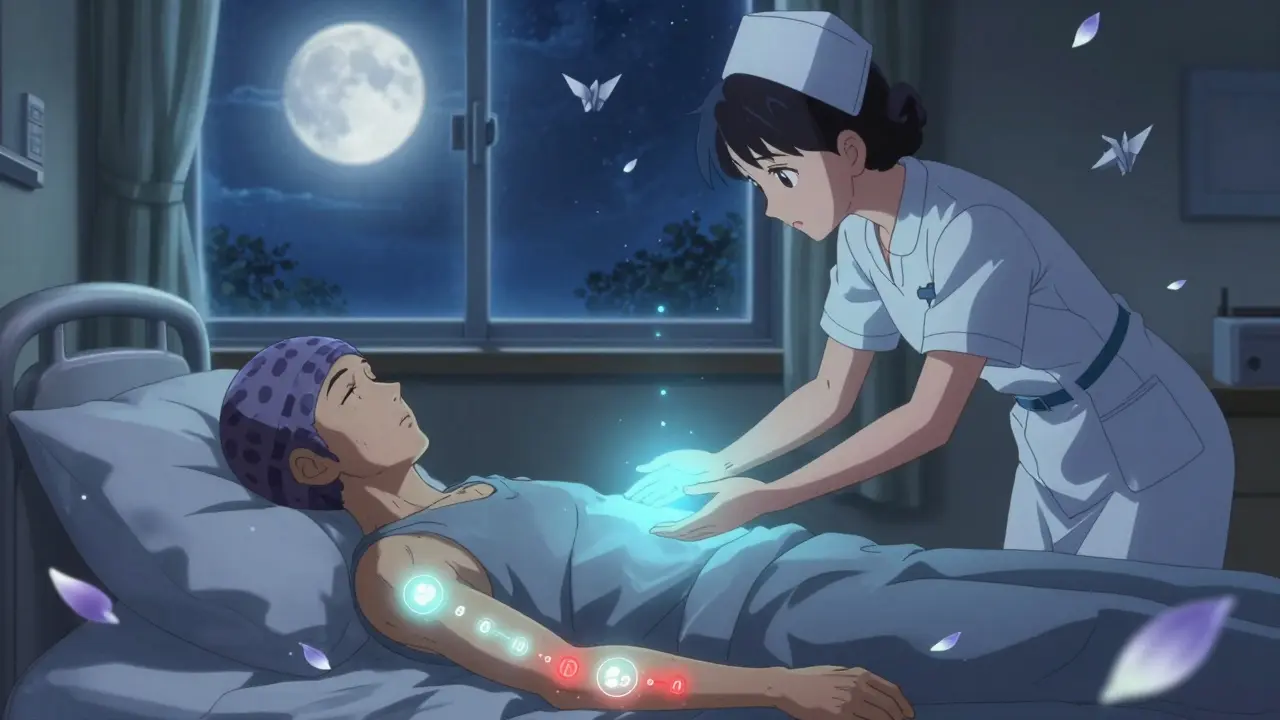
When someone is fighting cancer, the goal isn’t just to kill the disease-it’s to help them live as well as possible while they do. Too often, pain is ignored, downplayed, or misunderstood. But here’s the truth: cancer pain control isn’t optional. It’s essential. And when done right, it doesn’t just reduce suffering-it changes everything about how someone experiences their final months or years.
Why Cancer Pain Is Often Under-Treated
About 70 to 90% of people with advanced cancer will have pain at some point. Yet, studies show that nearly half of them still don’t get adequate relief. Why? It’s not because doctors don’t know how to help. It’s because of three big barriers. First, many patients are afraid of addiction. They’ve heard stories about opioids leading to dependency and worry they’ll become someone they don’t recognize. Second, some healthcare providers aren’t trained well enough. A 2017 study found that 40% of oncology nurses didn’t have up-to-date certification in pain management. Third, insurance often won’t cover non-drug treatments like physical therapy, acupuncture, or counseling-things that actually help a lot. Pain isn’t just a number on a scale. It’s the kind of ache that keeps you from sleeping, the burning that makes walking painful, the sharp stab when you cough. It’s not just physical-it’s emotional. It’s the guilt of being a burden, the fear of losing control, the loneliness when no one understands.The Three-Step Ladder: How Pain Medications Work
The World Health Organization laid out a simple, proven system over 30 years ago-and it still works today. It’s called the analgesic ladder, and it has three steps. Step 1: Mild pain (score of 1-3 on a 0-10 scale). Use over-the-counter meds like acetaminophen (no more than 4,000 mg a day) or ibuprofen (400-800 mg every 8 hours). These are safe for most people, but not if you have kidney disease or stomach ulcers. Step 2: Moderate pain (score of 4-6). Add a weak opioid like codeine. It’s usually combined with acetaminophen. This isn’t a big step up in strength, but it’s enough for many people who don’t respond to just NSAIDs. Step 3: Severe pain (score of 7-10). Strong opioids like morphine, oxycodone, or hydromorphone. Starting doses are low-usually 5-15 mg of morphine every 4 hours. But here’s the key: you don’t stay on that dose. You adjust it. If pain isn’t controlled after 24 hours, you increase the dose by 25-50%. And you always give extra doses for breakthrough pain-about 10-15% of your total daily amount. Opioids aren’t scary if used correctly. They’re not for everyone forever. But for someone with bone metastases or nerve damage from tumors, they’re life-changing. The CDC warns against high-dose opioids for chronic non-cancer pain-but cancer is different. The goal here isn’t to avoid opioids. It’s to use them wisely.What Else Helps Beyond Pills?
Medication isn’t the whole story. In fact, some of the biggest improvements in quality of life come from things that don’t involve drugs at all. Bone pain? Radiation therapy works wonders. A single 8 Gy dose can cut pain in half within days. For people with multiple sites, doctors might give 20-30 Gy total across several sessions. Bisphosphonates like zoledronic acid (given IV every 3-4 weeks) also help slow bone damage and reduce pain. Nerve pain? That burning, shooting feeling? That’s neuropathic pain. Gabapentin (100-1,200 mg three times a day) or pregabalin can calm those signals. Duloxetine, an antidepressant, also helps-especially if the patient is also feeling down. Inflammation or swelling? Dexamethasone (4-16 mg daily) can shrink tumors pressing on nerves or organs. It’s not a cure, but it can give someone back the ability to eat, breathe, or sit up without screaming. And don’t forget non-medical support. Physical therapy keeps muscles from stiffening. Massage eases tension. Music therapy lowers stress. Counseling helps families talk about what’s really going on. All of this is part of palliative care-and it’s covered under most insurance plans if you ask for it.
How Doctors Measure Pain-And Why It Matters
You can’t fix what you don’t measure. That’s why every major cancer group-NCCN, ESMO, ASCO-says pain must be checked at every visit. The standard tool? A 0-10 scale. Zero is no pain. Ten is the worst pain imaginable. Simple. But it’s not enough. Doctors also ask: Where is it? Is it sharp, dull, burning? When does it get worse? What makes it better? Does it stop you from walking, sleeping, or talking to your kids? Tools like the Brief Pain Inventory or McGill Pain Questionnaire give more detail. They help spot patterns. Maybe the pain gets worse at night-that could mean a tumor is pressing on a nerve. Maybe it flares after eating-that could be digestive involvement. And here’s the kicker: if pain is above a 7, reassessment must happen within an hour. If it’s 4-6, within four hours. Delaying reassessment means delaying relief. And time matters.When Opioids Don’t Work-or Cause Problems
Sometimes, opioids stop working. Not because the pain got worse-but because the body changed. One problem is opioid-induced hyperalgesia. That’s when the drugs themselves make you more sensitive to pain. It happens in 15-20% of people on high doses for months. The solution? Switch to a different opioid. Don’t just crank up the dose. Switch to fentanyl or methadone. Use an equianalgesic chart to convert safely-and start at 50-75% of the calculated dose. Why? Because your body hasn’t fully adapted to the new drug yet. Side effects like constipation, nausea, or confusion are common. Constipation? Start a laxative on day one. Don’t wait. Nausea? Try ondansetron. Confusion? Could be opioid neurotoxicity. Lower the dose, switch meds, or add an anti-seizure drug like haloperidol. And yes, respiratory depression is a risk. That’s why hospitals keep naloxone on hand. If breathing drops below 8 breaths per minute, give 0.4 mg diluted in saline. Slowly. Watch the person. You’re not trying to wake them up fully-you’re just making sure they’re safe.Why Early Palliative Care Saves Lives
Here’s the most powerful fact: if you bring in a palliative care team within eight weeks of diagnosis, people live longer. Seventeen studies show that patients who get early palliative care alongside their cancer treatment live 2.5 months longer on average. Not because they got more chemo. Not because they had surgery. Because their pain was controlled. Because they slept. Because they didn’t feel like a burden. Because they had time to talk about what mattered. Palliative care isn’t hospice. It’s not giving up. It’s adding support. A team of nurses, doctors, social workers, and chaplains who focus on your comfort, your dignity, your goals. They help you decide: Do you want to be at home? Do you want to travel? Do you want to be alert enough to hear your grandchild’s voice? The NCCN says every cancer center must offer immediate access to palliative care consultation. If your doctor doesn’t mention it-ask. Say: “I’m not ready to talk about end-of-life. But I am ready to talk about how to feel better.”
Cultural Barriers and Hidden Pain
Not everyone speaks up about pain. In many cultures, enduring pain quietly is seen as strength. Studies show 28% of Asian and Hispanic patients underreport pain because they don’t want to seem weak or complain. Doctors need to ask differently. Instead of “Are you in pain?” try: “On a scale of 0 to 10, how much is your pain interfering with your day?” Or: “What would it take for you to feel like you’re getting through this okay?” Families matter too. In some cultures, the family makes decisions-not the patient. The care team needs to understand that. They need to include the right people in conversations without overriding the patient’s voice.What’s New in 2026?
The field is changing fast. Smartphone apps now let patients log pain levels, sleep quality, and mood in real time. One 2021 study showed this improved documentation accuracy by 22%. That means doctors see the real picture-not just what was remembered at the last appointment. Genetic testing is starting to help. Some people metabolize morphine slowly because of their CYP2D6 gene. Others process it too fast. Testing can tell you which drug to pick-and what dose to start with. Artificial intelligence is being trained to predict pain patterns. If your tumor is growing in a certain way, the system can guess when pain will spike-before it happens. And 12 new non-opioid drugs are in late-stage trials. These target specific cancer pain pathways-like nerve compression or bone destruction-without the risk of addiction.What You Can Do Today
If you or someone you love has cancer:- Ask for a pain assessment at every visit. Don’t wait until it’s unbearable.
- Track your pain: note when it happens, what makes it better or worse, and how it affects your daily life.
- Ask about non-drug options: radiation, physical therapy, counseling.
- If opioids are prescribed, ask about side effect management-especially constipation.
- Request a palliative care consult. Say: “I want to make sure I’m not just surviving-I want to live well.”
Is palliative care the same as hospice?
No. Hospice is for people who are no longer seeking curative treatment and have a life expectancy of six months or less. Palliative care can start at diagnosis-even while someone is getting chemotherapy, surgery, or radiation. It’s about improving quality of life at any stage of illness.
Will opioids make me addicted?
For people with cancer, the risk of addiction is very low-under 1%. The goal isn’t to avoid opioids; it’s to use them to control pain so you can live. Physical dependence (needing the drug to avoid withdrawal) is common, but that’s not the same as addiction, which is compulsive use despite harm. Your doctor will monitor you closely.
What if my pain medicine stops working?
It doesn’t mean you’re out of options. You might need a different opioid, a higher dose, or an add-on medication like gabapentin or dexamethasone. Sometimes, radiation to a specific tumor site can suddenly make pain much better. Tell your team immediately-don’t wait. Pain that’s not controlled is a medical emergency.
Can I still get palliative care if I’m not near a big hospital?
Yes. Many palliative care teams offer telehealth visits. Community hospitals, home health agencies, and even some pharmacies now provide basic palliative support. Ask your oncologist for referrals. You don’t need to be in a major city to get help.
Does insurance cover palliative care?
Most insurance plans-including Medicare and Medicaid-cover palliative care services like doctor visits, nursing support, medications, and counseling. Non-drug therapies like acupuncture or massage may need pre-approval, but they’re often covered if recommended by your care team. Always ask your provider to submit a claim using the correct palliative care codes.
Tiffany Channell
January 2, 2026 AT 23:00The idea that opioids are somehow 'safe' for cancer patients is dangerously oversimplified. I've seen patients become sedated, confused, and constipated to the point of bowel obstruction-all because doctors were too eager to push morphine. The WHO ladder sounds nice on paper, but real people aren't algorithms. You don't just 'increase by 25-50%' and call it a day. Some bodies break. Some minds break. And no one talks about the dignity lost when you can't hold your own bowel movements because of a pill.
And don't get me started on 'palliative care saves lives.' Sure, if you're talking about survival statistics. But what about the people who die screaming because their pain was mismanaged for weeks while waiting for a consult? This isn't medicine. It's damage control dressed up as compassion.
Sarah Little
January 3, 2026 AT 06:36There's a significant pharmacokinetic disconnect between guideline-driven opioid titration and clinical reality. The CYP2D6 polymorphism data is underutilized in community oncology settings, leading to subtherapeutic or toxic plasma concentrations. Furthermore, the reliance on numeric pain scales ignores the affective dimension of nociception-particularly in somatic vs. neuropathic subtypes. Non-pharmacologic modalities like TENS and cognitive behavioral therapy are not adjuncts; they are first-line neuroplastic interventions that modulate central sensitization. The current model remains biomedical and reductionist, failing to integrate biopsychosocial frameworks into routine practice.
Insurance denials for acupuncture and physical therapy are not administrative oversights-they are systemic failures in value-based care design.
veronica guillen giles
January 5, 2026 AT 01:25Oh, so now we're giving out gold stars for not letting people die in agony? How noble. Let me grab my monocle and applaud the medical establishment for doing the bare minimum they were paid to do all along.
Meanwhile, the same system that tells you 'opioids aren't addictive in cancer' is the one that denied your mom's physical therapy because it 'wasn't medically necessary.' You think this is progress? It's just rebranding neglect as innovation. And don't even get me started on 'AI predicting pain'-because nothing says 'human care' like an algorithm guessing when you'll scream next.
Maybe if we stopped calling this 'palliative care' and just called it 'basic human decency,' we wouldn't need a 3,000-word manifesto to explain why people shouldn't suffer like dogs.
Ian Ring
January 6, 2026 AT 03:39I appreciate the thoroughness of this piece-really, it's one of the clearest summaries I've seen. The distinction between dependence and addiction is critical, and the mention of equianalgesic conversion is something that even many clinicians overlook.
Also, the point about cultural barriers? Vital. My mother-in-law, who's from rural Mexico, refused to report pain for weeks because 'it's a sign of weakness.' When we finally asked, 'What would make today bearable?'-she said, 'To sit in the sun without crying.' That's not a number on a scale. That's a life.
And yes-telehealth palliative care is a game-changer. We got it for my dad in rural Ohio. No hospital trip. Just a tablet, a nurse, and someone who actually listened. Thank you for writing this.
Angela Goree
January 7, 2026 AT 10:59America is falling apart because we’ve turned medicine into a bureaucracy. You want pain relief? You need 12 forms, 3 referrals, and a 6-week wait for a specialist who doesn’t even take your insurance. Meanwhile, China and Russia are giving cancer patients morphine on day one-no questions asked. We’re so afraid of opioids we let people die in silence. This isn’t healthcare. It’s American fear dressed in a white coat.
And don’t tell me about 'non-drug options'-when your bones are crumbling, a massage won’t fix that. Give me the drugs. Give me the relief. Stop making us beg for dignity.
Shanahan Crowell
January 8, 2026 AT 16:15This is the kind of post that gives me hope. Not because it’s perfect-but because it’s honest. Too many people think palliative care means giving up. It doesn’t. It means choosing to live fully, even when time is short.
I’ve been on both sides-family member and caregiver. The difference between someone who got early support and someone who didn’t? It’s not just pain levels. It’s laughter. It’s holding hands. It’s being able to hear your grandkid say 'I love you' without crying from pain.
If you’re reading this and you’re scared to ask for help-ask. Say it out loud. You deserve to feel human, not just a patient.
Kerry Howarth
January 9, 2026 AT 14:36Constipation prophylaxis should be standard on day one. Always. No exceptions.
Also: if your doctor doesn’t mention palliative care, ask. Not 'when.' Not 'if.' Ask. Now.
And opioids aren’t the enemy. Silence is.
Joy F
January 9, 2026 AT 21:14Let’s be real: this entire system is a performance. The WHO ladder? A 1986 relic. The '0-10 scale'? A toy for busy doctors who don’t want to sit with you. The 'AI predicting pain'? A marketing pitch for tech startups who’ve never held a dying hand.
And don’t even get me started on 'cultural barriers.' You think a Hispanic grandmother doesn’t know her own pain? She’s just tired of being lectured by people who think her silence is ignorance, not wisdom.
This isn’t about better drugs. It’s about better listening. And no algorithm, no guideline, no 'palliative consult' can replace that. We’ve turned suffering into a protocol-and that’s the real tragedy.
Haley Parizo
January 11, 2026 AT 08:15What is pain, really? Not the sensation-but the meaning behind it? In many indigenous traditions, pain is a messenger. Not a problem to be silenced, but a signal that something is out of alignment-spiritually, emotionally, socially. Modern medicine treats pain like a glitch in the machine. But what if it’s not a glitch? What if it’s the soul screaming to be heard?
We give morphine to numb the body, but we refuse to sit with the grief, the guilt, the terror that comes with it. We treat the symptom, not the story. And that’s why so many people die alone-even surrounded by machines and people who mean well.
Maybe the real breakthrough isn’t in genetics or AI. Maybe it’s in learning to hold space-for pain, for silence, for the unspeakable.
Ian Detrick
January 13, 2026 AT 07:28My dad was diagnosed with stage IV pancreatic cancer. We didn’t bring in palliative care until he was in the ER, screaming, unable to breathe. By then, his kidneys were failing from dehydration because he couldn’t eat. He’d been told to 'push through' the pain.
They gave him morphine. He slept for 36 hours. Woke up. Asked for ice chips. Told us he loved us. Held my hand. Died two days later.
If we’d had this info six weeks earlier? He would’ve had those two days-clean, calm, present. Not just surviving. Living.
Thank you for writing this. I’m sharing it with every family I know.
Angela Fisher
January 14, 2026 AT 03:58They say opioids aren't addictive in cancer-but what if they’re just a distraction? What if the real pain isn’t in the bones? What if it’s in the system? The same system that gives you a pill but won’t cover your therapist? The same system that lets Big Pharma write the guidelines? I’ve seen people given morphine while their insurance denied their wheelchair. That’s not care. That’s manipulation.
And AI predicting pain? Please. They’re training it on data from hospitals that don’t even speak Spanish. How’s that gonna help my abuela? They don’t even have the right codes in their system.
And the '12 new non-opioid drugs'? They’ll cost $20,000 a month. You think that’s for people like us? No. It’s for the rich. The rest of us get the same old lies: 'It’ll get better.' 'Just hold on.' 'We’re doing everything we can.'
Wake up. This isn’t medicine. It’s a money machine with a stethoscope.