
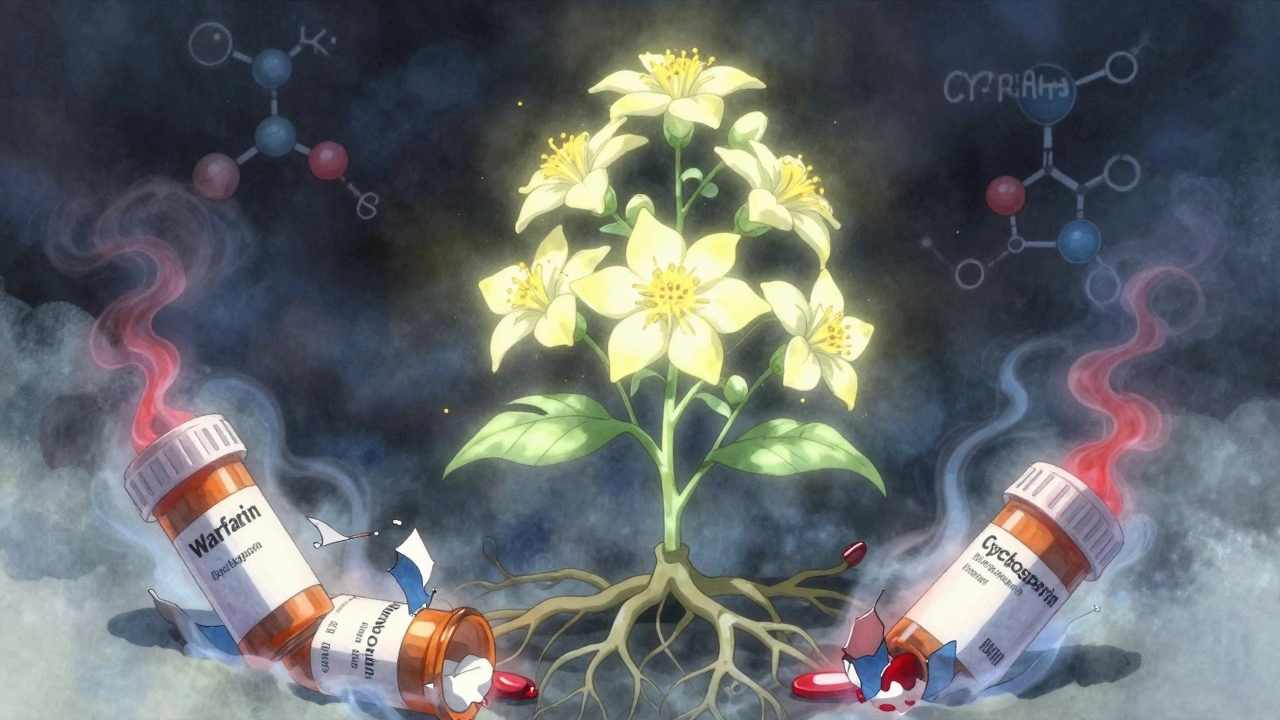
St. John’s Wort looks harmless. It’s sold on pharmacy shelves next to vitamin D and melatonin, often labeled as "natural" or "herbal." But this plant - Hypericum perforatum - isn’t just a gentle mood lifter. It’s a powerful biochemical actor that can quietly sabotage your prescription meds, sometimes with life-threatening results.
How St. John’s Wort Changes Your Body’s Drug Processing
St. John’s Wort doesn’t just float through your system. It actively rewires how your body handles medications. The key culprits are hyperforin and hypericin - compounds in the herb that turn on liver enzymes called cytochrome P450, especially CYP3A4. This enzyme is responsible for breaking down about half of all prescription drugs on the market.
When St. John’s Wort wakes up CYP3A4, your body starts churning through medications faster than normal. That means drugs like warfarin, birth control pills, or cyclosporin don’t stay in your bloodstream long enough to work. The result? Blood clots you didn’t expect, an unplanned pregnancy, or organ rejection after a transplant.
It’s not just speed. St. John’s Wort also activates P-glycoprotein, a protein that pumps drugs out of cells. This further reduces how much medicine actually reaches your target organs. And here’s the twist: when you stop taking St. John’s Wort, those same enzymes calm down. Suddenly, your meds aren’t being broken down as fast - so levels spike. That’s when toxicity kicks in. One patient on cyclosporin after a kidney transplant ended up in the hospital after quitting St. John’s Wort - their drug levels doubled overnight.
Medications That Can Become Ineffective or Dangerous
St. John’s Wort doesn’t pick and choose. It hits a wide range of critical drugs. Here’s what you need to watch for:
- Antidepressants - SSRIs like sertraline, fluoxetine, and escitalopram. Combine them with St. John’s Wort and you risk serotonin syndrome: agitation, rapid heart rate, high fever, seizures. This isn’t a mild side effect - it’s a medical emergency.
- Blood thinners - Warfarin (Coumadin), rivaroxaban (Xarelto). St. John’s Wort cuts their effectiveness. One study showed patients on warfarin had INR levels drop by over 30% after starting the herb - putting them at risk for stroke or pulmonary embolism.
- Birth control - Oral contraceptives. Multiple cases report breakthrough bleeding and unintended pregnancies in women taking both. The herb speeds up estrogen metabolism. IUDs and patches? Data is limited, but the risk is too high to assume safety.
- Immunosuppressants - Cyclosporin and tacrolimus. Used after organ transplants. A drop in levels can mean your body attacks the new organ. The FDA has received reports of kidney transplant failures linked to St. John’s Wort.
- Antiseizure drugs - Phenytoin (Dilantin), carbamazepine (Tegretol). Lower drug levels mean more seizures. One patient had three breakthrough seizures in two weeks after starting the herb.
- HIV meds - Protease inhibitors and non-nucleoside reverse transcriptase inhibitors. These drugs keep viral loads down. St. John’s Wort can drop them below therapeutic levels, leading to drug-resistant HIV.
- Antipsychotics - Clozapine. St. John’s Wort reduces its concentration, making psychosis harder to control.
- Methadone - Used for opioid addiction. Lower levels mean withdrawal symptoms, cravings, and increased risk of relapse.
- Anti-migraine drugs - Triptans like sumatriptan. Combined with St. John’s Wort, they raise serotonin levels dangerously high.
- Statins - Atorvastatin and simvastatin. Reduced effectiveness means higher cholesterol and increased heart disease risk.
Even over-the-counter drugs aren’t safe. Fexofenadine (Allegra) can build up to toxic levels if taken with St. John’s Wort. Omeprazole (Prilosec) loses its acid-reducing power. Photosensitizing drugs - like tetracycline or certain diuretics - become more likely to cause severe sunburns.
Why the Risks Are Worse Than You Think
Many people assume herbal means safe. But St. John’s Wort is more like a pharmaceutical agent than a tea. The concentration of active compounds varies wildly between brands - even between batches. One pill might have 0.3% hyperforin; another might have 1.8%. That’s a sixfold difference. No one knows what’s really in the bottle you bought online.
And here’s the silent danger: most doctors don’t ask about supplements. Patients don’t think to mention them. A 2023 study in the Journal of Clinical Pharmacy and Therapeutics found that 78% of patients taking St. John’s Wort never told their doctor. That’s not negligence - it’s ignorance. People believe "natural" equals harmless. But your liver doesn’t care if something comes from a plant or a lab. It only sees chemicals.
Worse, the effects aren’t always immediate. You might take St. John’s Wort for weeks before your birth control fails. Or your antidepressant stops working. By the time symptoms show up, the damage is done.

What Happens When You Stop Taking It?
Stopping St. John’s Wort isn’t a clean break. Your liver enzymes stay turned on for days - sometimes weeks. When they finally slow down, your meds start building up again. That’s when toxicity hits.
One patient in Australia was on warfarin and stopped taking St. John’s Wort after three months. Within 10 days, their INR shot from 2.1 to 6.8 - nearly three times the safe upper limit. They nearly bled out. Another patient on cyclosporin had kidney failure after quitting the herb because their drug levels spiked.
There’s no universal timeline. It depends on your metabolism, how long you took it, and the dose. But if you’re planning to quit St. John’s Wort, talk to your doctor first. You may need blood tests and dose adjustments.
Who Should Never Use It
St. John’s Wort isn’t for everyone - and for many, it’s a hard no:
- Anyone on prescription meds - especially those listed above
- People with bipolar disorder - it can trigger mania
- Pregnant or breastfeeding women - no safety data exists
- Patients with organ transplants
- Those with a history of serotonin syndrome
- Anyone scheduled for surgery - it can interfere with anesthesia
If you’re considering it for depression, know this: studies show it works about as well as low-dose SSRIs for mild cases. But the risks aren’t worth it when safer, regulated options exist. Talk therapy, exercise, and FDA-approved antidepressants have known safety profiles. St. John’s Wort doesn’t.

What to Do Instead
Don’t stop your meds cold. Don’t swap them for herbs without supervision. If you’re unhappy with your current treatment, talk to your doctor. Ask about:
- Switching to a different antidepressant with fewer interactions
- Adding cognitive behavioral therapy (CBT)
- Trying mindfulness or light therapy - both have strong evidence for mild depression
- Checking your vitamin D and B12 levels - deficiencies mimic depression
If you’re already taking St. John’s Wort, don’t panic. But do this: write down every medication and supplement you take. Bring it to your next appointment. Ask your pharmacist to run an interaction check. If you’re on anything listed above, stop the herb - but only under medical supervision.
Bottom Line: It’s Not Worth the Risk
St. John’s Wort is a classic example of why "natural" doesn’t mean safe. It’s not a gentle herb. It’s a drug - one that interferes with dozens of life-saving medications. The FDA doesn’t regulate it like a drug because it’s sold as a supplement. But your body treats it like one.
If you’re taking any prescription medicine, avoid St. John’s Wort. Period. If you’re already using it, talk to your doctor before making any changes. And if you’re considering it for depression, anxiety, or sleep - there are safer, better-studied options out there. Your health isn’t a gamble. Don’t risk it for something that might not even help.
Can St. John’s Wort interact with over-the-counter medications?
Yes. St. John’s Wort can interfere with common OTC drugs like fexofenadine (Allegra), omeprazole (Prilosec), and even some pain relievers when taken with other medications. It can also increase sun sensitivity, making sunscreen less effective and raising the risk of severe sunburns. Always assume it interacts unless proven otherwise.
Is it safe to take St. John’s Wort with birth control pills?
No. St. John’s Wort speeds up the breakdown of estrogen in the liver, reducing the pill’s effectiveness. There have been multiple documented cases of unplanned pregnancies in women taking both. Even if you’ve been on the pill for years, adding this herb can cause breakthrough bleeding or failure. Other birth control methods like IUDs or patches haven’t been studied enough to say they’re safe.
How long does it take for St. John’s Wort to affect other drugs?
Effects can start within a few days, but full enzyme induction usually takes 1-2 weeks. That’s why people don’t notice problems right away. The danger is that the interaction builds silently. By the time a pill stops working or a side effect appears, the damage may already be done.
Can I take St. John’s Wort if I’m not on any meds?
Even if you’re not currently on prescription drugs, it’s not advisable. Many people take medications occasionally - antibiotics, painkillers, or even heartburn meds. You might not think you’re on anything, but your body could still be affected. Also, St. John’s Wort can cause side effects like anxiety, dizziness, dry mouth, and photosensitivity. It’s not harmless.
Are there any safe herbal alternatives to St. John’s Wort?
For mild depression, omega-3 fatty acids, saffron extract, and regular exercise have shown promise in clinical studies with fewer interaction risks. Light therapy is also effective, especially for seasonal depression. Always check with your doctor before starting any new supplement, even if it’s labeled "natural."
Why do some people say St. John’s Wort works for them?
Some people with very mild depression may feel better on it - but that doesn’t mean it’s safe or reliable. Placebo effects, lifestyle changes, or natural mood fluctuations can explain improvement. The real danger is when someone believes it’s working and stops taking their prescribed antidepressant. That’s when serious relapses happen.
What should I do if I accidentally took St. John’s Wort with my medication?
Stop taking the herb immediately. Contact your doctor or pharmacist. Don’t wait for symptoms. If you’re on warfarin, birth control, or an immunosuppressant, you may need urgent blood tests. Keep a record of what you took, how much, and when. This helps your provider assess risk.
Is St. John’s Wort regulated like a drug?
No. In the U.S., it’s sold as a dietary supplement, meaning the FDA doesn’t test it for safety, purity, or effectiveness before it hits shelves. Manufacturers aren’t required to prove it works or that it won’t interact with medications. That’s why product quality varies so much - and why the risks are so high.
St. John’s Wort might seem like a simple fix for low mood. But behind that quiet bottle is a powerful, unpredictable force - one that can turn your life-saving meds into useless pills. Don’t gamble with your health. When in doubt, leave it out.
Jessica Baydowicz
December 5, 2025 AT 14:14I took St. John’s Wort for three months thinking it was just a ‘natural boost’-then my birth control failed and I ended up in the ER with a panic attack because my SSRIs stopped working. Don’t be me.
Martyn Stuart
December 5, 2025 AT 14:31Let me be clear: St. John’s Wort is not a supplement-it’s an unregulated pharmaceutical agent with no quality control. The hyperforin content in one bottle can vary by 600% between batches. If you’re taking it, you’re gambling with your liver, your hormones, and your life. Please, for the love of science, stop.
Joe Lam
December 6, 2025 AT 07:22Wow. Another fear-mongering article from someone who clearly doesn’t understand how the body works. People have used this herb for centuries. Your ‘life-threatening’ claims are exaggerated to sell more SSRIs.
Scott van Haastrecht
December 7, 2025 AT 01:25Joe Lam is the reason people die. He thinks centuries of herbal tradition override peer-reviewed pharmacology. If you’re reading this and still taking St. John’s Wort, you’re not just ignorant-you’re a liability to yourself and everyone around you.
Heidi Thomas
December 7, 2025 AT 09:31Stop overreacting. I’ve been on it for years with my antidepressants and nothing happened. You’re just scared of natural stuff because Big Pharma doesn’t own it.
Alex Piddington
December 9, 2025 AT 04:53Heidi, I understand your skepticism-but your anecdote doesn’t override population-level data. The FDA has documented over 1,200 adverse events linked to St. John’s Wort since 2015. Your body might be fine. Mine isn’t. And I’m not risking it.
Gillian Watson
December 9, 2025 AT 11:38My mum took this after her husband passed. Said it helped her sleep. She was on blood pressure meds. Never told her doctor. She ended up with a mini-stroke. I wish someone had told us this sooner.
Libby Rees
December 9, 2025 AT 14:07It’s not about natural vs synthetic. It’s about biochemistry. The liver doesn’t care if a compound comes from a plant or a lab. It reacts to structure. St. John’s Wort alters enzyme activity. That’s science. Not opinion.
Bill Wolfe
December 9, 2025 AT 21:01Look. I get it. You want to feel better without a prescription. But you’re not ‘being natural’-you’re being reckless. You’re not a pioneer. You’re a walking drug interaction waiting to happen. And when you end up in the hospital, don’t blame the doctor. Blame yourself for trusting a bottle from a gas station.
Also, emojis? 😒
val kendra
December 10, 2025 AT 04:29My therapist recommended light therapy instead. It’s free, no interactions, and I actually sleep better. Also, I started walking 30 mins a day. No magic herb. Just movement and sunlight. Crazy, I know.
Rudy Van den Boogaert
December 11, 2025 AT 19:20My cousin took this with her transplant meds. Her body rejected the kidney. She’s on dialysis now. She thought it was just for anxiety. No one warned her. No one even asked. If you’re on anything serious-anything-don’t touch it. Not even once.
Dematteo Lasonya
December 12, 2025 AT 13:23Thank you for writing this. I’m a nurse, and I see this every week. People don’t realize their ‘natural remedy’ is quietly undoing their treatment. I wish more doctors asked about supplements instead of assuming patients won’t tell them. We need better communication-not more fear.