

Vitamin K Intake Calculator
Track Your Vitamin K Intake
Consistent vitamin K intake is the most important factor for stable INR levels while on warfarin. Track your daily intake to avoid dangerous swings.
Add Food
Your Daily Vitamin K
Total Vitamin K
0 mcg
Consistency Level
Your target range: 50-200 mcg/day
How This Works
Why consistent intake matters: Warfarin works by blocking vitamin K. If your intake varies significantly day-to-day, your INR becomes unstable. Even if your average is correct, swings can cause dangerous bleeding or clotting risks.
Article insights: Patients who eat 150 mcg every day had 18% fewer INR swings than those who varied intake but maintained the same average. Consistency is key.
When you're on warfarin, your life isn't just about taking a pill every day. It's about what you eat-especially how much vitamin K you get. One day you eat a big salad, your INR drops. Next week you skip the greens, your INR spikes. That’s not luck. That’s vitamin K working against your medication. And if you don’t track it, you’re playing Russian roulette with your blood.
Why Vitamin K Matters More Than You Think
Warfarin doesn’t make your blood thinner by thinning it. It blocks vitamin K, which your body needs to make clotting factors. Too little vitamin K? Your blood won’t clot enough-you could bleed internally. Too much? Warfarin can’t do its job-you’re at risk for a clot, stroke, or pulmonary embolism. The sweet spot? An INR between 2.0 and 3.5. But that range doesn’t stay put if your diet swings like a pendulum.The numbers don’t lie. The FDA found that inconsistent vitamin K intake causes 32% of warfarin-related ER visits. That’s not rare. That’s common. And it’s avoidable. The American Heart Association says consistent vitamin K intake is the single most modifiable factor in keeping your INR stable. Not your dose. Not your timing. Your food.
What Foods Are High in Vitamin K?
You don’t need to avoid these foods. You need to eat them the same way, every day.- Cooked kale: 817 mcg per 100g (about 1 cup)
- Cooked spinach: 483 mcg per 100g
- Cooked broccoli: 220 mcg per 100g
- Romaine lettuce: 138 mcg per 100g (2 cups raw)
- Soybean oil, canola oil: 20-30 mcg per tablespoon
- Fortified meal shakes like Ensure: 25 mcg per 8 oz
That’s not a list of foods to fear. It’s a list of foods to track. A single serving of cooked spinach can give you over 400 mcg-more than four times the daily recommended intake for women. But if you eat that same serving every Tuesday and Thursday, your body adjusts. If you eat it one week and skip it the next? Your INR goes wild.
Food Diaries: Paper vs. Digital
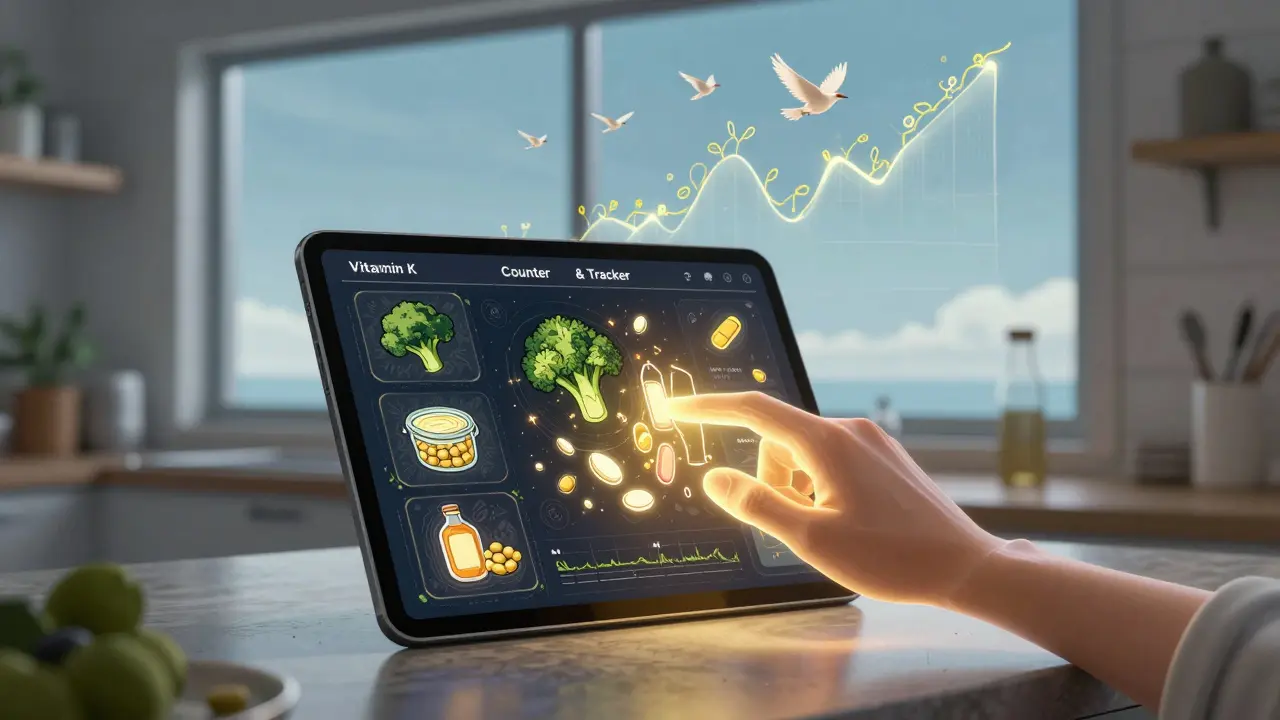
For decades, patients wrote down meals on paper. Simple. Reliable. But easy to lose. A 2022 study showed 82% of patients over 75 stuck with paper diaries-because smartphones were too confusing. But for everyone else? Digital tools win.The Vitamin K Counter & Tracker app (version 4.2.1, updated 2023) has a database of 1,200+ foods, all verified against the USDA. You scan a barcode, type in a meal, or pick from photos. It instantly tells you how much vitamin K you just ate. It even shows you a graph of your weekly intake. In a 6-month trial with 327 patients, app users stayed in their target INR range 72.3% of the time. Paper users? Only 61.8%. That’s a 10.5% absolute improvement-and it’s life-saving.
But not all apps are equal. A 2023 review found 68% of vitamin K apps lack clinical validation. Some free apps misreport vitamin K by 30% or more. The Vitamin K-iNutrient app, validated by the University of Toronto, hits 94.7% accuracy. It’s worth $2.99. Free apps? Not worth the risk.
The Hidden Traps
People think they’re tracking well. They log their kale. They forget the salad dressing. Or the soy sauce. Or the protein bar with canola oil. Or the multivitamin with 50 mcg of vitamin K. That’s where things break.Research shows patients underreport vitamin K by 22-37%. Why? Because they don’t know where it hides. Soybean oil is in 70% of processed foods. Canola oil is in chips, dressings, baked goods. Multivitamins? Often overlooked. One patient told me he took his vitamin daily-until his doctor pointed out his multivitamin had 100 mcg of K. His INR had been climbing for months.
Portion size is another trap. “A cup of spinach” sounds small. But when you’re eyeballing it? You might eat three cups. Visual portion guides-like comparing a serving to a tennis ball or a deck of cards-cut estimation errors by 41%.
How to Start a Food Diary That Works
You don’t need to be perfect. You need to be consistent.- Choose your tool: Use a validated app like Vitamin K Counter & Tracker, or a paper log from your clinic.
- Track everything for 30 days: Include every meal, snack, drink, supplement. No exceptions.
- Find your baseline: After 30 days, calculate your average daily vitamin K intake. Is it 100 mcg? 150? 200? That’s your new normal.
- Stick to it: Don’t go from 50 mcg to 300 mcg. Stay within 20% of your baseline. If you want to eat more kale, add it slowly-and tell your doctor.
- Review weekly: Look at your INR trends. If your INR drops after eating broccoli three days in a row? That’s your body’s feedback.
Some clinics offer meal-planning help. The University of Michigan found that patients who pre-planned five days of meals with consistent vitamin K levels improved their INR stability by 15%. That’s not magic. That’s structure.
What Experts Say
Dr. Gary Raskob, lead author of the 2021 American Society of Hematology guidelines, says: “The most important advice is to maintain your usual dietary pattern.” He’s not saying don’t eat greens. He’s saying don’t change your habits suddenly.Dr. Evan Stein from the University of Chicago put it bluntly: “Avoiding high-vitamin K foods is less effective than eating them consistently.” Patients who ate 150 mcg every day had 18% fewer INR swings than those who varied their intake-even if their average was the same.
The Agency for Healthcare Research and Quality reviewed 12 studies and found dietary tracking boosted time in therapeutic range by 8.2 percentage points. That’s the difference between a safe INR and a dangerous one.
Real Stories, Real Results
On Reddit’s r/Anticoagulants, one user wrote: “Using the app cut my INR swings from monthly to quarterly. Tracking broccoli portions stopped my dose changing every two weeks.” That’s not hype. That’s data.Another said: “I lost two weeks of my paper diary. It got wet in my pocket. Switched to the app-hated typing, but now I never miss a day.”
At VA clinics, 76% of patients approved of food diaries. But 42% needed two visits to learn how to use them. That’s not failure. That’s normal. This isn’t intuitive. It’s a skill. And like any skill, it takes practice.
What’s Next?
The future is here. In January 2024, the FDA approved NutriKare-an AI system that takes a photo of your food and estimates vitamin K content with 89% accuracy. Epic Systems added vitamin K tracking to MyChart in 2023. Soon, your EHR will auto-adjust your warfarin dose based on what you ate.But for now? You don’t need AI. You need a diary. And consistency. That’s it.
Warfarin isn’t going away. It’s still the only option for mechanical heart valves. Over 120,000 new patients get them every year in the U.S. And for them, food diaries aren’t optional. They’re life insurance.
Can I just stop eating leafy greens on warfarin?
No. Avoiding greens entirely isn’t safer-it’s riskier. Your body needs vitamin K to function. The goal isn’t to eliminate it, but to keep your intake steady. If you suddenly stop eating spinach after eating it daily for months, your INR can spike dangerously high. Consistency beats avoidance.
Do I need to track every single meal?
For the first 30 days, yes. After that, you can relax a bit-but still track major changes. If you eat a big bowl of kale on Saturday, log it. If you skip dinner? Don’t stress. The goal is spotting patterns, not perfection. Missing one day won’t ruin your INR. Missing five days in a row might.
What if my doctor doesn’t mention food diaries?
Ask. The American Heart Association gives dietary tracking a Class I recommendation-meaning it’s standard of care. If your clinic doesn’t offer it, request it. Bring printouts of the guidelines. Many providers don’t realize how effective this simple tool is. You’re not being pushy-you’re being proactive.
Can I use MyFitnessPal or Lose It! for vitamin K tracking?
You can, but don’t rely on it. A 2023 JAMA study found general nutrition apps are 3.2 times less accurate for vitamin K than specialized tools. They often mislabel oils, sauces, and supplements. For warfarin, accuracy matters. Use an app built for this, not one built for weight loss.
How long does it take to see results from a food diary?
Most patients see INR stability within 4-6 weeks. The first two weeks are about learning. Weeks 3-4, you’ll start spotting patterns. By week 6, you’ll know how your body reacts to your meals. Some see results faster-especially if they had wild INR swings before.
Is it worth paying for a vitamin K app?
Absolutely. A $2.99 app is cheaper than one ER visit. Free apps often have 30%+ errors in vitamin K data. The Vitamin K Counter & Tracker app has been validated in multiple studies. Paying for accuracy isn’t a luxury-it’s a safety net.
What if I travel or eat out often?
Stick to your baseline. Ask for dressing on the side. Avoid kale salads. Choose grilled chicken over sautéed veggies. Most restaurants use soybean or canola oil-so if you eat fried foods, assume they’re high in K. Log it anyway. When in doubt, be conservative. Your INR will thank you.
Amy Vickberg
January 15, 2026 AT 00:45After 3 years on warfarin, I finally got my INR stable by tracking vitamin K with the app mentioned. No more panic calls to my nurse every time I ate a salad. I used to think I was doing fine until I saw the graph-my intake swung from 50 to 400 mcg like a yo-yo. Now I eat the same amount of kale every Tuesday and Thursday. It’s boring, but it’s safe. I wish I’d started sooner.
Ayush Pareek
January 16, 2026 AT 12:26This is one of the most practical health guides I’ve read in years. I’m from India, and we eat a lot of spinach and mustard greens-traditionally cooked with spices and oil. I never realized how much vitamin K was in those. Now I measure my portions with a spoon and log them. My INR went from 4.2 to 2.8 in six weeks. Thank you for the clarity.
Nicholas Urmaza
January 18, 2026 AT 10:38If you’re not tracking your vitamin K you’re not managing your warfarin-you’re gambling. The data is crystal clear. 32% of ER visits? That’s preventable. And yet doctors still act like it’s optional. Your life isn’t a suggestion. It’s a protocol. Stop making excuses. Get the app. Log everything. Your future self will thank you.
Sarah Mailloux
January 19, 2026 AT 11:51I used to hate logging meals but now I’m weirdly obsessed. I love seeing the little chart go flat. It’s like a video game where the reward is not bleeding out. Also-soy sauce is a sneaky one. I thought it was just salt. Turns out it’s basically vitamin K in a bottle. Who knew?
Amy Ehinger
January 20, 2026 AT 04:42My grandma used to write everything in a little notebook she kept in her purse. She’d forget to bring it to the doctor sometimes, so she’d just recite from memory and hope she didn’t miss anything. I switched her to the app last year-she cried because she said it felt like she had a personal assistant. She’s 81 and she logs her meals every night before bed. It’s not about tech-it’s about making it easy enough that you actually do it. And honestly? It’s kind of comforting. Like you’re in control again.
RUTH DE OLIVEIRA ALVES
January 21, 2026 AT 00:05It is imperative to underscore the clinical significance of dietary consistency in anticoagulation management. The American Heart Association’s Class I recommendation for vitamin K monitoring is not merely advisory-it constitutes a standard of care grounded in empirical evidence. The documented 8.2 percentage point increase in time within therapeutic range is statistically and clinically robust. Patients who disregard this intervention are not merely inconvenienced-they are exposed to preventable morbidity and mortality. Healthcare providers must institutionalize dietary tracking protocols, and patients must be empowered-not merely informed.
Crystel Ann
January 22, 2026 AT 07:36I had no idea soybean oil was in everything. I thought I was eating healthy with all my salads and grilled chicken. Turns out my salad dressing had more vitamin K than the lettuce. And my protein bar? Yeah, that was a disaster. I’ve been tracking for two weeks now and my INR hasn’t budged. I didn’t even know I was doing it wrong until I read this. Thank you for the wake-up call.
Nat Young
January 22, 2026 AT 23:54So let me get this straight. I’m supposed to eat the same exact amount of kale every week or my blood might clot? And this is better than just switching to one of those new pills? Sounds like they’re just trying to keep us dependent on outdated meds. What about the fact that these apps are owned by Big Pharma? You think they really care about your INR or just your subscription fee?
Tom Doan
January 23, 2026 AT 00:08Interesting how the article calls free apps ‘not worth the risk’-yet doesn’t mention that the ‘validated’ app is funded by a company that also sells warfarin. Coincidence? Or conflict of interest masked as clinical guidance? The FDA doesn’t regulate food tracking apps like drugs. So who’s validating them? A grad student with Excel? I’ve seen more accurate vitamin K data in a 2007 nutrition textbook.
Sohan Jindal
January 24, 2026 AT 09:08They want you to track your food so they can control you. This isn’t medicine-it’s surveillance. Who gave the government the right to tell you what you can eat? I’m not logging anything. I take my pill and eat what I want. If I die, I die. But I won’t be a slave to a phone app. This is America. Not China. Not the WHO. You don’t need a diary to live. You need freedom.